What is the best room temperature for sleep?
What bedroom sensors revealed about the ideal sleep temperature, why heat disturbs sleep more than cold under a duvet, and how a warm bath or socks help.

Katja Michel, M.Ed. · 4 min read
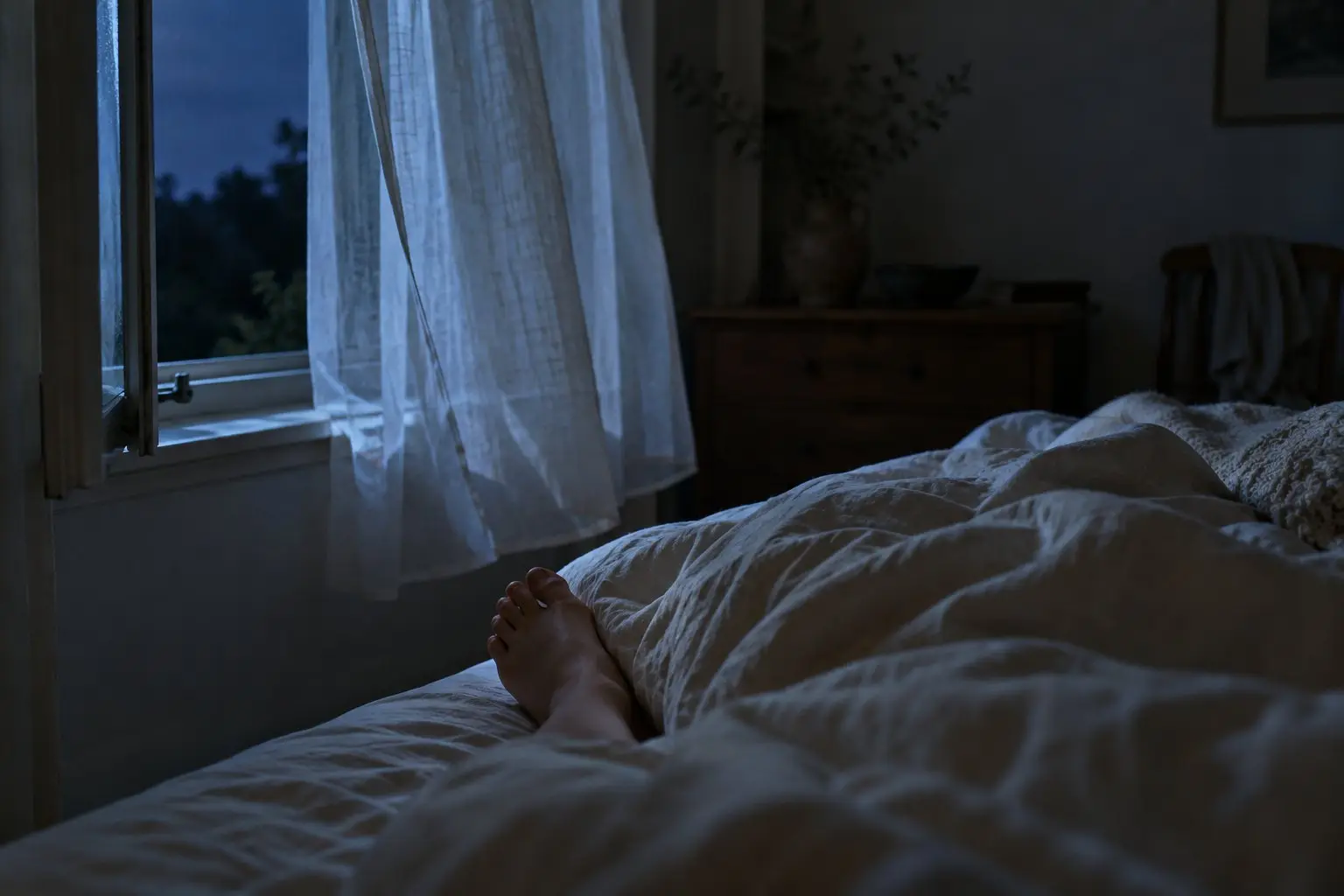
There is no single perfect number, but a moderately cool to comfortable room suits most people, and heat is the bigger enemy. In a study that measured older adults’ bedrooms and sleep at home, sleep was most efficient between 68 and 77 °F and got clearly worse as rooms warmed further. Bedding matters as much as the thermostat, and warming your feet or taking a warm bath before bed can help you fall asleep.
Key takeaways
- In real-life conditions with bedding, heat disturbs sleep more than cold does, increasing wakefulness and reducing deep and REM sleep.
- Cold mainly affects sleep when people lie uncovered; with blankets and clothing, sleep stages stayed largely intact in cool rooms.
- Older adults slept less efficiently on nights when their bedrooms reached warmer temperatures, with large differences between individuals.
- A warm shower or bath well before bed helped people fall asleep faster in a meta-analysis.
- Bed socks shortened the time to fall asleep in a small lab study in a cool room.
Is a cold or a warm bedroom better for sleep?
A bedroom that isn’t too hot is better for most people. A review of the research on thermal environment and sleep found that both heat and cold can increase wakefulness and reduce deep and REM sleep. In real life, where people use bedding and clothing, heat was the bigger problem, and humid heat worse still, while cold exposure didn’t change sleep stages as long as bedding kept people warm, though it did affect heart rhythm regulation during sleep (Okamoto-Mizuno & Mizuno, 2012).
The widely repeated advice of a bedroom between 60 and 67 °F has little direct research behind it. I couldn’t find a trial that tested that exact range, so treat it as a rule of thumb.
What temperature did the bedroom studies find best?
In older adults at home, sleep was best in a moderate range and got worse as rooms warmed. A study in community-dwelling older adults combined wearable sleep monitors with bedroom temperature sensors over long periods at home. Sleep was most efficient and restful in the moderate range, and efficiency dropped by a clinically relevant 5 to 10 percent when bedrooms warmed from the top of that range to 86 °F (30 °C). The relationship wasn’t linear, and individuals differed a lot (Baniassadi et al., 2023).
The authors point out that this matters most for people who can’t cool their homes, and that a warming climate may make it a problem for more people.
Does a warm bath before bed help you sleep?
Yes, a warm bath or shower helps if you time it right. A meta-analysis of studies on warm showers and baths before bed found that water at about 40 to 42.5 °C, 104 to 108.5 °F, improved self-rated sleep quality and sleep efficiency, and that a bath or shower one to two hours before bedtime, even for as little as ten minutes, shortened the time to fall asleep. The authors explain this through the drop in core body temperature as the body releases heat through the hands and feet afterward, and call for more research (Haghayegh et al., 2019).
Do socks help you sleep?
Bed socks possibly help in a cool room. In a small lab study, six young men slept at 23 °C, about 73 °F, with and without warming bed socks. With socks, they fell asleep 7.5 minutes faster, slept 32 minutes longer and woke up less often (Ko & Lee, 2018). Six participants is very few, but the result fits the warm-bath findings about heat loss through the feet.
What I’d do
- Keep the bedroom on the cool side of comfortable, and use bedding you can adjust.
- Prioritize cooling in summer: open windows at night, use a fan or air conditioning, and switch to a lighter duvet.
- Take a warm shower or bath one to two hours before bed if you struggle to fall asleep.
- Try socks if your feet get cold.
- Keep a regular sleep rhythm too, as explained in Is going to bed at the same time more important than eight hours?
Frequently asked questions
Why do I sleep badly in summer? Heat increases wakefulness and reduces deep and REM sleep, especially when it is humid (Okamoto-Mizuno & Mizuno, 2012). In older adults, warmer nights went with less efficient sleep (Baniassadi et al., 2023).
Does a hot shower right before bed keep you awake? The studies in the meta-analysis found benefits when the shower or bath was taken one to two hours before bed (Haghayegh et al., 2019), so allow some time for your body to cool down.
Can a sleep tracker tell me if the room is too warm? Not reliably on its own. Trackers estimate sleep stages, and how good those estimates are is explained in Are sleep trackers accurate?
Sources
- Baniassadi, A., Manor, B., Yu, W., Travison, T., & Lipsitz, L. (2023). Nighttime ambient temperature and sleep in community-dwelling older adults. Science of the Total Environment, 899, 165623. https://doi.org/10.1016/j.scitotenv.2023.165623
- Haghayegh, S., Khoshnevis, S., Smolensky, M. H., Diller, K. R., & Castriotta, R. J. (2019). Before-bedtime passive body heating by warm shower or bath to improve sleep: A systematic review and meta-analysis. Sleep Medicine Reviews, 46, 124–135. https://doi.org/10.1016/j.smrv.2019.04.008
- Ko, Y., & Lee, J. Y. (2018). Effects of feet warming using bed socks on sleep quality and thermoregulatory responses in a cool environment. Journal of Physiological Anthropology, 37(1), 13. https://doi.org/10.1186/s40101-018-0172-z
- Okamoto-Mizuno, K., & Mizuno, K. (2012). Effects of thermal environment on sleep and circadian rhythm. Journal of Physiological Anthropology, 31, 14. https://doi.org/10.1186/1880-6805-31-14