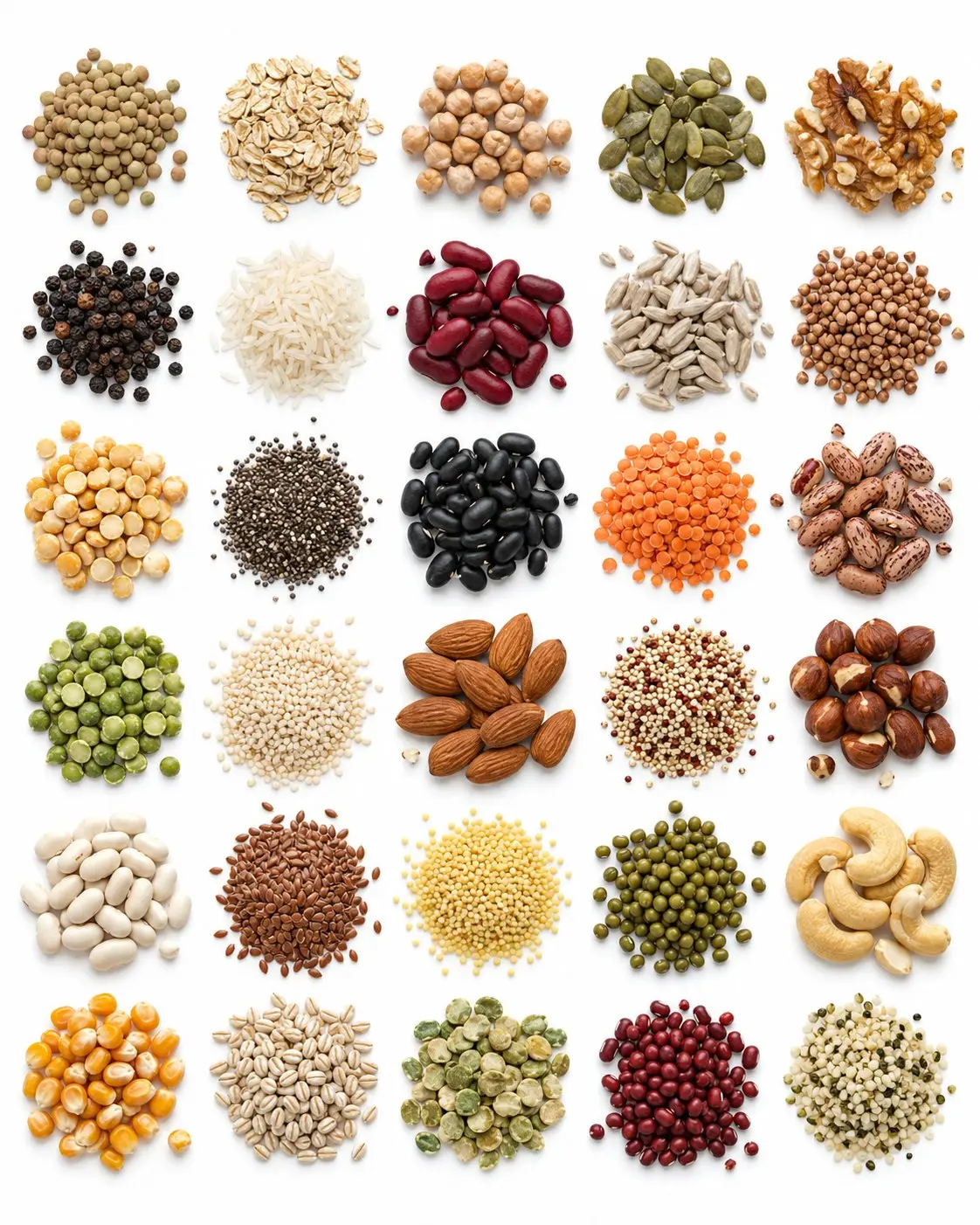
Why plant variety matters, and what 30 really means
About 30 different plants a week is a useful goal for your gut bacteria. In the American Gut Project, a citizen science study with more than 10,000 volunteers, people who ate more than 30 plant types a week had more bacteria that ferment fiber than people who ate 10 or fewer (McDonald et al., 2018). It is an observation, so the number works as a target and is no proven threshold.
Key takeaways
- In the same study, the number of plant types explained more about people’s gut bacteria than labels like “vegan” or “omnivore”.
- Different bacteria break down different fibers, which is the likely reason variety matters.
- In a small randomized trial, fermented foods increased the diversity of gut bacteria within weeks, and a high-fiber diet changed what the bacteria could digest.
- People who ate the most fiber had 15 to 30 % lower rates of early death, heart disease, stroke and type 2 diabetes in long-term studies.
- Herbs, spices, nuts, seeds, beans and whole grains all count, which makes 30 easier than it sounds.
Where does the number 30 come from?
From one large comparison in a volunteer study. The American Gut Project collected stool samples by mail from people mainly in the US, the UK and Australia, along with a food questionnaire that recorded how many different plants they ate in a typical week (McDonald et al., 2018). When the researchers compared the two ends of that scale, the high-variety group had more bacteria that produce short-chain fatty acids from fiber, among them Faecalibacterium prausnitzii. They also carried fewer genes for resistance to some antibiotics.
The finding that surprised the researchers most concerned diet labels. Whether people called themselves vegan or omnivore did not map onto their gut bacteria in any meaningful way, while the number of plant types did. A vegan who lives on the same five foods may be further from the target than an omnivore with a full vegetable drawer.
The limits are worth knowing. The participants chose to take part, the food data came from a questionnaire, and the study shows associations at one point in time. The target is the cut-off of one comparison and doesn’t mark the point where benefits begin.
Why would variety matter to gut bacteria?
Because each species has its own tools. The American Gut team explains that bacteria differ in the enzymes they use to break down carbohydrates, so a diet with many kinds of fiber and resistant starch likely supports a more diverse community (McDonald et al., 2018). Oats and lentils bring other fibers than onions or walnuts, and a bacterium that thrives on one may ignore another. Resistant starch is one of those fibers, and the article on cooled carbohydrates explains how cooking and cooling create more of it.
Can food change your gut bacteria?
Yes, though not always in the way people expect. In a randomized trial, 36 healthy adults followed either a high-fiber diet or a diet rich in fermented foods for 17 weeks (Wastyk et al., 2021). The fermented-food group steadily gained bacterial diversity and showed lower levels of several inflammation markers. In the high-fiber group, diversity stayed stable, but the bacteria produced more of the enzymes that break down fiber, so they changed what they could do.
The trial is small. With 18 people per group, its results need confirming, and its main immune measure did not change in the high-fiber group. It suggests that fermented foods and plant variety work on the gut in different ways, and that eating both is a reasonable bet.
Does a varied gut mean better health?
The link between plants and health is clearer than the link between gut bacteria and health. A large series of reviews pooled 185 long-term studies and 58 clinical trials on fiber (Reynolds et al., 2019). In the long-term studies, people who ate the most fiber had lower rates of early death, heart disease, stroke, type 2 diabetes and colorectal cancer than those who ate the least. In the trials, more fiber lowered body weight, systolic blood pressure and cholesterol. The benefits were largest at 25 to 29 grams of fiber a day, and the article on fiber shows what that looks like on a plate.
The two goals overlap. Variety helps you get there, because every new plant brings its own fiber. Vegetables and fruit are also one of the five habits that large studies link with a longer life, which the long-life habits test checks.
What I’d do
- Count your plants for one normal week before you change anything.
- Buy mixed versions: frozen berry mixes, mixed beans, mixed seeds and salad mixes add several plants at once.
- Swap one familiar grain for a new one each week, such as barley, buckwheat or bulgur.
- Finish meals with herbs and spices, since they count too.
- Add a fermented food like yogurt, kefir or sauerkraut a few times a week.
- Increase fiber over a few weeks rather than overnight if beans and lentils make you bloated.
Sources
- McDonald, D., Hyde, E., Debelius, J. W., Morton, J. T., Gonzalez, A., Ackermann, G., Aksenov, A. A., Behsaz, B., Brennan, C., Chen, Y., DeRight Goldasich, L., Dorrestein, P. C., Dunn, R. R., Fahimipour, A. K., Gaffney, J., Gilbert, J. A., Gogul, G., Green, J. L., Hugenholtz, P., … Knight, R. (2018). American Gut: An open platform for citizen science microbiome research. mSystems, 3(3), e00031-18. https://doi.org/10.1128/mSystems.00031-18
- Reynolds, A., Mann, J., Cummings, J., Winter, N., Mete, E., & Te Morenga, L. (2019). Carbohydrate quality and human health: A series of systematic reviews and meta-analyses. The Lancet, 393(10170), 434–445. https://doi.org/10.1016/S0140-6736(18)31809-9
- Wastyk, H. C., Fragiadakis, G. K., Perelman, D., Dahan, D., Merrill, B. D., Yu, F. B., Topf, M., Gonzalez, C. G., Van Treuren, W., Han, S., Robinson, J. L., Elias, J. E., Sonnenburg, E. D., Gardner, C. D., & Sonnenburg, J. L. (2021). Gut-microbiota-targeted diets modulate human immune status. Cell, 184(16), 4137–4153. https://doi.org/10.1016/j.cell.2021.06.019