Does dancing keep your brain young?
A famous dementia cohort first linked dancing to brain health, and trials in older adults tested which dance styles help thinking, mood and balance.

Katja Michel, M.Ed. · 4 min read
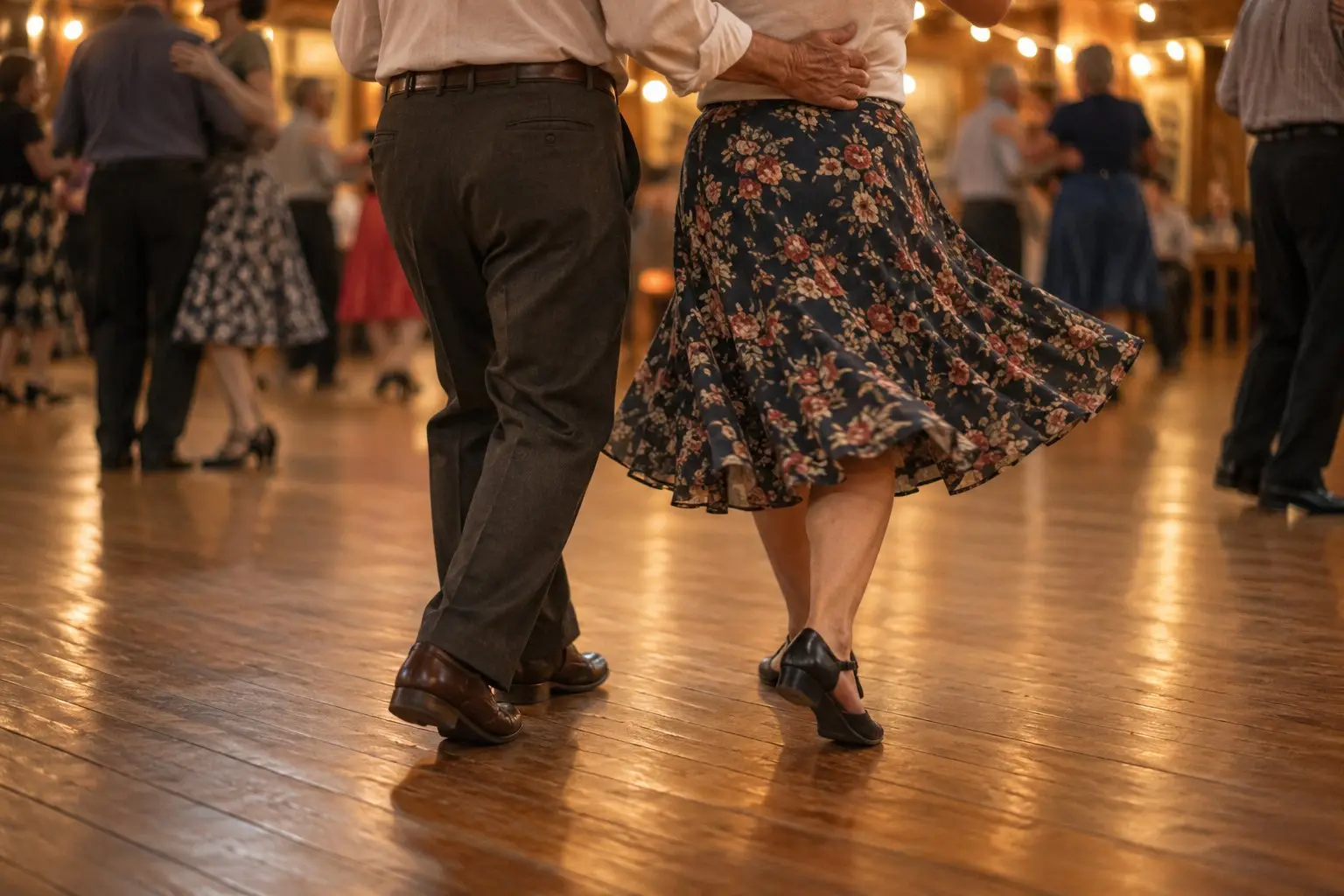
Dancing is good for the aging brain, though by a modest amount. Randomized trials in older adults found small improvements in thinking and somewhat larger improvements in mood, and in an often-cited cohort study, dancing was among the leisure activities linked to a lower risk of dementia. Because dancing also trains balance and brings people together, it is a well-rounded hobby to pick up in later life.
Key takeaways
- In a cohort of adults over 75, dancing was one of several mentally active pastimes linked to a lower dementia risk.
- A meta-analysis of randomized trials in adults over 60 found that dance improved thinking slightly and depressive symptoms moderately.
- In a network comparison of five dance styles, ballroom dancing improved cognitive function most clearly.
- Tango and folk dancing improved balance, which matters for preventing falls.
- Researchers study dance as more than exercise, because it trains body, memory and social contact at once.
Is dancing linked to a lower risk of dementia?
Yes, dancing was linked to a lower risk of dementia in the study that made the idea famous. Researchers followed 469 community-dwelling adults over 75 without dementia for a median of about five years. Among their leisure activities, reading, playing board games, playing musical instruments and dancing were associated with a lower risk of dementia. Mentally active pastimes in general showed the link, and it held after excluding people who may already have been in the early stage of dementia (Verghese et al., 2003).
That was an observational study of a few hundred people. It shows a link, not proof. Reading appears in the same study and in other research, covered in Do people who read books live longer?
What do dance trials show?
Dance trials in older adults show small but real benefits for thinking and mood. A 2025 meta-analysis of randomized trials included 13 trials with 1,174 participants aged 60 and older who were healthy or had mild cognitive impairment. Dance interventions improved cognition by a small amount and depressive symptoms by a nearly moderate amount compared with other conditions, and no particular feature of the programs explained the differences between trials (Jaldin et al., 2025). Dancing won’t turn back the clock on memory tests, but for a pastime people choose for pleasure, a small gain in thinking and a clearer one in mood is a respectable result.
Which style of dance is best for the brain?
Ballroom dancing was the only style that significantly improved cognitive function in a network meta-analysis of 28 studies with 1,967 older adults, which compared five types of dance. Tango and folk dancing improved balance, tango and self-created dance improved mobility, and square dancing improved mental health (Zhang et al., 2025). Comparisons like these may rest on only a few studies per style, so treat the ranking as a hint.
Is dancing better than other exercise for the brain?
Possibly, but the evidence doesn’t settle it. Researchers point out that dance combines physical, cognitive and social elements in one activity (Jaldin et al., 2025), which ordinary exercise often doesn’t. Brain training apps, by contrast, haven’t shown much transfer to everyday thinking, as explained in Do brain games keep your mind sharp?
What I’d do
- Join a dance class in a style you enjoy.
- Go regularly for a few months before you judge it.
- Choose partner or group dances for the social side as well, since company is part of why hobbies help, as in Do hobbies make you healthier?
- Start gently and ask your doctor first if you have balance problems or heart disease.
Frequently asked questions
Is it too late to start dancing at 70? The trials included people aged 60 and older, and benefits appeared in that group (Jaldin et al., 2025).
Does dancing alone at home count? Most trials used classes. Dancing at home is still movement, but the social and learning parts of a class may matter too.
How often should you dance? The meta-analysis found that no particular feature of the programs explained the differences between trials (Jaldin et al., 2025), so I can’t give a tested dose.
Sources
- Jaldin, M. A., Balbim, G. M., Pinto, J., Negrete, M., Motl, R. W., Bustamante, E. E., et al. (2025). Systematic review and meta-analysis of the effects of dance on cognition and depression in healthy older adults. Medicine & Science in Sports & Exercise, 57(3), 490–500. https://doi.org/10.1249/mss.0000000000003585
- Verghese, J., Lipton, R. B., Katz, M. J., Hall, C. B., Derby, C. A., Kuslansky, G., et al. (2003). Leisure activities and the risk of dementia in the elderly. The New England Journal of Medicine, 348(25), 2508–2516. https://doi.org/10.1056/nejmoa022252
- Zhang, H., Gao, Y., Zhang, Y., & Ma, H. (2025). Effects of dance interventions on cognitive function, balance, mobility, and life quality in older adults: A systematic review and Bayesian network meta-analysis. Archives of Gerontology and Geriatrics, 131, 105775. https://doi.org/10.1016/j.archger.2025.105775