Is matcha better for you than coffee?
Matcha and coffee side by side on caffeine, focus, a long life, iron and contaminants, and what the popular claims about each leave out.

Katja Michel, M.Ed. · 9 min read
How much caffeine is in your own day? Take the one-minute test
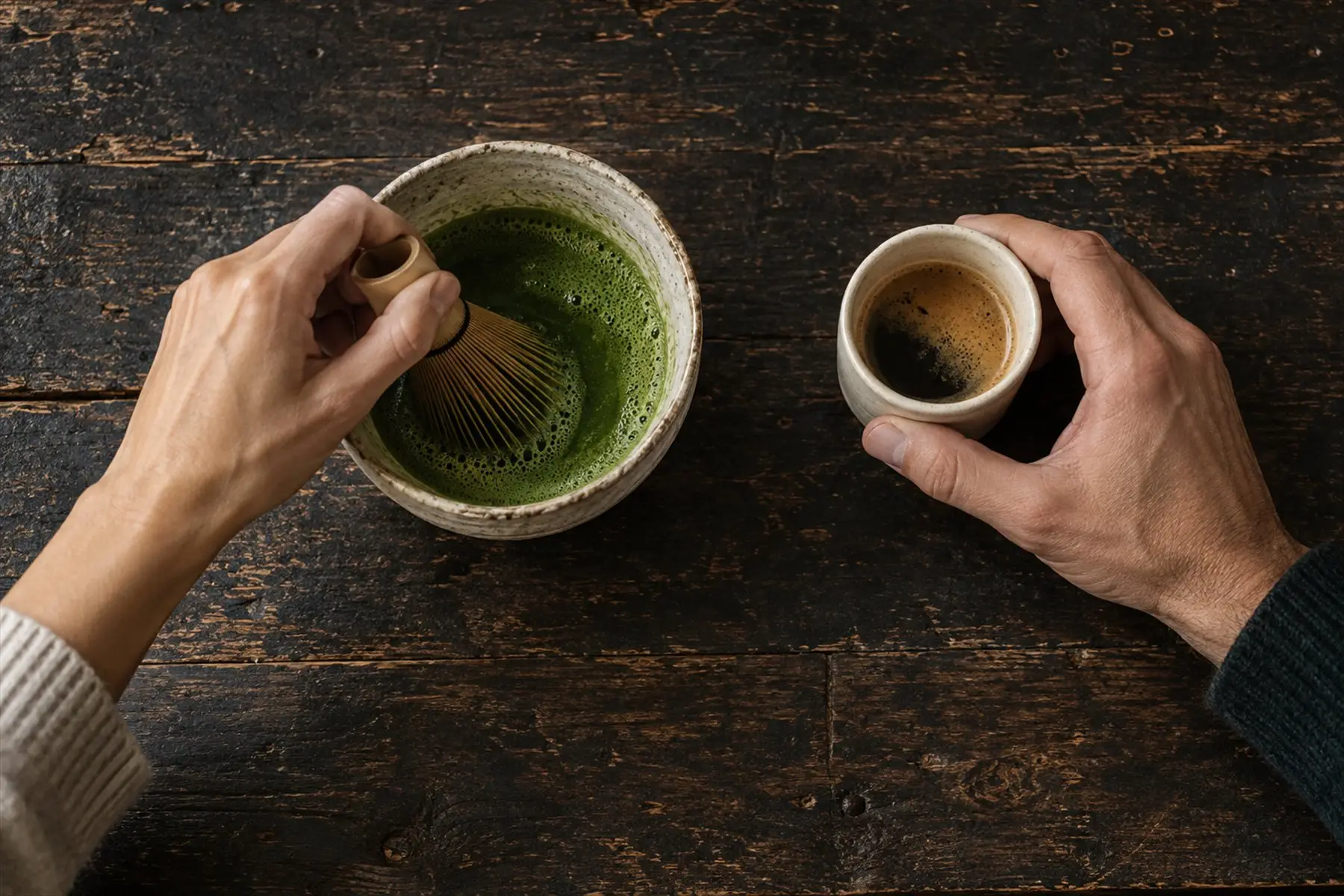
For most people, neither drink is clearly healthier. Coffee has far more long-term evidence behind it, while matcha usually gives you a smaller dose of caffeine along with some L-theanine, and that smaller dose explains much of its gentle reputation. Which one suits you depends on how you handle caffeine, when you drink it and what you eat with it.
Key takeaways
- A bowl of matcha usually holds less caffeine than a mug of coffee.
- I found no human study that tested the “slow release” story about matcha.
- The famous “137 times more antioxidants” claim is a myth.
- Coffee has far more long-term research behind it than matcha.
- Choose matcha from a trusted source, because you drink the whole leaf.
How do matcha and coffee compare?
Coffee has more caffeine and far more long-term research, while matcha has less caffeine, some L-theanine and a contamination question that coffee doesn’t share.
Coffee and matcha at a glance
| Brewed coffee (8 oz / 240 ml) | Matcha (about 2 g powder) | |
|---|---|---|
| Caffeine | about 95 mg | from under 10 mg to about 70 mg, depending on the product |
| L-theanine | none | some (about 48 mg in one tested product) |
| Long-term human data | large, mostly observational | almost none for matcha itself; some for green tea |
| Main downside | sleep, if drunk late; unfiltered coffee raises LDL cholesterol | you swallow the whole leaf, including what it absorbed from the soil |
| Iron absorption with a meal | reduced | reduced |
Caffeine and L-theanine values come from the U.S. Department of Agriculture (n.d.), one matcha trial (Baba et al., 2021a) and a laboratory analysis (Kika et al., 2024).
Where do matcha and coffee come from?
Both drinks began as aids for tired monks. The Zen monk Eisai brought tea seeds back to Japan from China in 1191 and later wrote Kissa Yōjōki, usually translated as Drinking Tea for Health; in Zen practice, tea was valued as a mild stimulant against sleepiness during meditation (Encyclopedia of World Biography, n.d.). Matcha’s own history goes back to 13th-century Japanese Zen monks who drank it to stay focused through long hours of meditation (Najman et al., 2023). By the mid-fifteenth century, several thousand miles west, Sufi communities in Yemen were brewing coffee to keep their concentration through long religious rituals (Liu & Xu, 2026).
Both drinks were chosen for the same job, keeping a tired person attentive, and both have kept it for more than five hundred years. What changed is the marketing.
Why does coffee make some people jittery when matcha doesn’t?
Mostly because a bowl of matcha usually contains less caffeine than a mug of coffee. L-theanine may smooth the edges a little, but the dose does most of the work, and the popular explanation for the difference has never been tested.
Anyone who has felt “anxious and wired” after a second or third coffee knows the experience people are describing. The standard explanation, repeated by tea shops and by many of the articles that rank for this question, is that the L-theanine in matcha slows down how quickly caffeine is absorbed, so the energy arrives gently, lasts four to six hours and never crashes. It’s a tidy story. I couldn’t find a single human study that measured caffeine absorption from matcha against coffee, let alone one that timed a crash. Until someone runs that study, it’s an assumption dressed as physiology.
What has been tested is the combination of caffeine and L-theanine as isolated ingredients. In a 2008 trial with 27 volunteers, 50 mg of caffeine taken with 100 mg of L-theanine improved speed and accuracy on an attention-switching task more than caffeine alone (Owen et al., 2008). A 2010 trial with 44 young adults (40 mg of caffeine, 97 mg of L-theanine) improved accuracy on task switching and made people feel more alert and less tired, while visual search, reaction time and mental rotation didn’t change (Giesbrecht et al., 2010). A 2014 meta-analysis of 11 placebo-controlled studies found moderate effects on alertness and attention switching in the first two hours, and noticed that the caffeine dose seemed to matter more than the L-theanine dose (Camfield et al., 2014).
Those trials used about twice as much L-theanine as caffeine. The one matcha serving I found measured in a published trial contained the opposite ratio, 48 mg of L-theanine to 66 mg of caffeine (Baba et al., 2021a). So a bowl of matcha is a different thing from the doses tested in the lab, and nobody has shown that it produces their effect.
There are small trials of matcha itself. In 42 young adults, two weeks of daily matcha helped people hold their attention after a mildly stressful task (Baba et al., 2021b). In 99 older adults with early memory complaints, a year of matcha left the main measures of cognitive function unchanged, though it improved how well they read emotions in faces (Uchida et al., 2024). At least one matcha trial in this area was run by employees of the tea company Ito En (Baba et al., 2021a), and results like these deserve independent replication before anyone builds a promise on them.
The practical reading is simple. If coffee makes you jittery, you are probably reacting to the dose, and a smaller dose in any form will help. The caffeine and anxiety article covers who reacts most, and decaf is the extreme version of a smaller dose.
How much caffeine is in matcha compared with coffee?
Usually less, though the range is wide. Brewed coffee contains about 40 mg of caffeine per 100 ml, roughly 95 mg in an 8-ounce cup (USDA, n.d.). Matcha is harder to pin down because you drink the powdered leaf, and its caffeine varies with the plant and the harvest: the 2-gram daily serving in one Japanese trial contained 66 mg (Baba et al., 2021a), while a 2024 laboratory analysis found only about 2 mg per gram in another powder (Kika et al., 2024). Unless the label lists caffeine, you can’t tell which end of that range your tin sits on.
The U.S. Food and Drug Administration considers up to 400 mg a day generally unproblematic for healthy adults, while noting that sensitivity and the speed of clearing caffeine differ widely (FDA, n.d.). Pregnancy is a separate conversation to have with your doctor or midwife.
Does matcha really have 137 times more antioxidants?
No. The number comes from a 2003 laboratory study that measured EGCG, the best-known catechin in green tea, and compared matcha with one particular green tea sold as China Green Tips. Per gram of leaf, matcha delivered 137 times more. The same paper reported that against the highest values published for other green teas, the difference was “at least three times” (Weiss & Anderton, 2003).
Matcha does contain more catechins than steeped green tea, because you drink the leaf instead of an infusion of it, and three times more is a real difference. One hundred and thirty-seven is the number that survives on packaging because it is the more exciting one.
Does either drink help you live longer?
Regular coffee and green tea are both linked to slightly longer lives, and coffee has the stronger file. A 2017 umbrella review in The BMJ, which pulled together more than 200 meta-analyses, found the largest reduction in risk at three to four cups of coffee a day compared with none, including a 17 percent lower risk of death from any cause (Poole et al., 2017). Pregnancy and women at high risk of fractures were the exceptions.
For green tea, a pooled analysis of eight Japanese cohorts with more than 313,000 people followed for an average of 17 years found that those who drank five or more cups a day had a 10 percent (men) and 18 percent (women) lower risk of death than those who drank less than one, mainly through fewer deaths from heart disease and stroke (Abe et al., 2019).
Both are observational: coffee and tea drinkers differ from non-drinkers in ways no model fully corrects for. The Japanese studies looked at green tea in general, and nobody has followed matcha drinkers for decades. (More on green tea itself: Is green tea good for you?)
What are the downsides of coffee and matcha?
Coffee’s main one is cholesterol, and only for some brews. Coffee beans contain cafestol, the most potent cholesterol-raising compound known in the human diet (Ricketts et al., 2007), and it reaches the cup mainly in unfiltered coffee such as boiled, Turkish or French press. A meta-analysis of 12 randomized trials found that coffee raised total and LDL cholesterol, more so when unfiltered (Cai et al., 2012). If your LDL is high, the French press is the first thing to look at.
Both drinks reduce iron absorption when you have them with food. In a classic study, a cup of coffee with a meal cut iron absorption by 39 percent and tea by 64 percent; coffee an hour before the meal had no effect, while coffee an hour after still did (Morck et al., 1983). If your iron runs low, the timing of your cup matters more than the choice between them.
Matcha’s particular downside follows from its particular advantage. You drink the whole leaf, so you also drink what the plant took up from soil and spray. In a 2026 Austrian consumer test of 14 matcha powders, organic products were generally lower in lead and aluminum than conventional ones, and all three conventional powders contained pesticide residues, one above the legal limit (VKI & AK Steiermark, 2026). A Czech analysis found that 5 g of matcha a day stays below tolerable intakes for aluminum, tin, cadmium and mercury (Koláčková et al., 2020). A careful choice of source is the sensible precaution, and for a daily bowl it’s about all it takes.
One thing that sounds alarming and isn’t relevant to the drink: the European Food Safety Authority found that green tea extract supplements delivering 800 mg of EGCG a day or more can raise liver enzymes (EFSA, 2018). The trial serving above contained 170 mg of all catechins combined (Baba et al., 2021a). The risk belongs to concentrated pills.
What I’d do
- Switch to matcha, decaf or a smaller coffee if coffee makes you jittery, and expect the smaller dose to be what helps.
- Keep your coffee if you sleep well and like it, and make it filtered if your cholesterol is high.
- Move tea and coffee away from meals if your iron tends to be low.
- Buy matcha from a seller who publishes lab results for heavy metals and pesticides.
- Check the sugar in café matcha lattes, which often matters more than the tea.
Frequently asked questions
Can I drink matcha if I’m sensitive to caffeine? Often yes, because a typical serving contains less caffeine than coffee. It still contains caffeine, so count it, and be careful with large or strong servings.
Can I drink matcha every day? For healthy adults, a bowl or two a day from a carefully sourced product fits well within caffeine limits. If you’re pregnant, count it toward your daily caffeine.
Is a matcha latte healthy? The matcha in it is the same as in a bowl. Café versions often add a lot of sugar, which changes the picture more than the tea does.
Sources
- Abe, S. K., Saito, E., Sawada, N., Tsugane, S., Ito, H., Lin, Y., Tamakoshi, A., Sado, J., Kitamura, Y., Sugawara, Y., Tsuji, I., Nagata, C., Sadakane, A., Shimazu, T., Mizoue, T., Matsuo, K., Naito, M., Tanaka, K., & Inoue, M. (2019). Green tea consumption and mortality in Japanese men and women: A pooled analysis of eight population-based cohort studies in Japan. European Journal of Epidemiology, 34(10), 917–926. https://doi.org/10.1007/s10654-019-00545-y
- Baba, Y., Inagaki, S., Nakagawa, S., Kobayashi, M., Kaneko, T., & Takihara, T. (2021a). Effects of daily matcha and caffeine intake on mild acute psychological stress-related cognitive function in middle-aged and older adults: A randomized placebo-controlled study. Nutrients, 13(5), 1700. https://doi.org/10.3390/nu13051700 (Authors employed by ITO EN.)
- Baba, Y., Kaneko, T., & Takihara, T. (2021b). Matcha consumption maintains attentional function following a mild acute psychological stress without affecting a feeling of fatigue: A randomized placebo-controlled study in young adults. Nutrition Research, 88, 44–52. https://doi.org/10.1016/j.nutres.2020.12.024
- Cai, L., Ma, D., Zhang, Y., Liu, Z., & Wang, P. (2012). The effect of coffee consumption on serum lipids: A meta-analysis of randomized controlled trials. European Journal of Clinical Nutrition, 66(8), 872–877. https://doi.org/10.1038/ejcn.2012.68
- Camfield, D. A., Stough, C., Farrimond, J., & Scholey, A. B. (2014). Acute effects of tea constituents L-theanine, caffeine, and epigallocatechin gallate on cognitive function and mood: A systematic review and meta-analysis. Nutrition Reviews, 72(8), 507–522. https://doi.org/10.1111/nure.12120
- EFSA Panel on Food Additives and Nutrient Sources added to Food. (2018). Scientific opinion on the safety of green tea catechins. EFSA Journal, 16(4), Article 5239. https://doi.org/10.2903/j.efsa.2018.5239
- Encyclopedia of World Biography. (n.d.). Eisai. In Encyclopedia.com. https://www.encyclopedia.com/people/philosophy-and-religion/buddhism-biographies/eisai
- Giesbrecht, T., Rycroft, J. A., Rowson, M. J., & De Bruin, E. A. (2010). The combination of L-theanine and caffeine improves cognitive performance and increases subjective alertness. Nutritional Neuroscience, 13(6), 283–290. https://doi.org/10.1179/147683010X12611460764840
- Kika, J., Jakubczyk, K., Ligenza, A., Maciejewska-Markiewicz, D., Szymczykowska, K., & Janda-Milczarek, K. (2024). Matcha green tea: Chemical composition, phenolic acids, caffeine and fatty acid profile. Foods, 13(8), Article 1167. https://doi.org/10.3390/foods13081167
- Koláčková, T., Sumczynski, D., Zálešáková, L., Šenkárová, L., Orsavová, J., & Lanczová, N. (2020). Free and bound amino acids, minerals and trace elements in matcha (Camellia sinensis L.): A nutritional evaluation. Journal of Food Composition and Analysis, 92, Article 103581. https://doi.org/10.1016/j.jfca.2020.103581
- Liu, X., & Xu, S. (2026). Unraveling the complexities of caffeine: Metabolism, genetics, evolution, and health. Hereditas, 163(1), 36. https://doi.org/10.1186/s41065-026-00648-z
- Morck, T. A., Lynch, S. R., & Cook, J. D. (1983). Inhibition of food iron absorption by coffee. The American Journal of Clinical Nutrition, 37(3), 416–420. https://doi.org/10.1093/ajcn/37.3.416
- Najman, K., Sadowska, A., Wolińska, M., Starczewska, K., & Buczak, K. (2023). The content of bioactive compounds and technological properties of matcha green tea and its application in the design of functional beverages. Molecules, 28(20), 7018. https://doi.org/10.3390/molecules28207018
- Owen, G. N., Parnell, H., De Bruin, E. A., & Rycroft, J. A. (2008). The combined effects of L-theanine and caffeine on cognitive performance and mood. Nutritional Neuroscience, 11(4), 193–198. https://doi.org/10.1179/147683008X301513
- Poole, R., Kennedy, O. J., Roderick, P., Fallowfield, J. A., Hayes, P. C., & Parkes, J. (2017). Coffee consumption and health: Umbrella review of meta-analyses of multiple health outcomes. BMJ, 359, Article j5024. https://doi.org/10.1136/bmj.j5024
- Ricketts, M. L., Boekschoten, M. V., Kreeft, A. J., Hooiveld, G. J. E. J., Moen, C. J. A., Müller, M., Frants, R. R., Kasanmoentalib, S., Post, S. M., Princen, H. M. G., Porter, J. G., Katan, M. B., Hofker, M. H., & Moore, D. D. (2007). The cholesterol-raising factor from coffee beans, cafestol, as an agonist ligand for the farnesoid and pregnane X receptors. Molecular Endocrinology, 21(7), 1603–1616. https://doi.org/10.1210/me.2007-0133
- U.S. Department of Agriculture. (n.d.). FoodData Central: Coffee, brewed (FDC ID 171890). https://fdc.nal.usda.gov/food-details/171890/nutrients
- U.S. Food and Drug Administration. (n.d.). Spilling the beans: How much caffeine is too much? https://www.fda.gov/consumers/consumer-updates/spilling-beans-how-much-caffeine-too-much
- Uchida, K., Meno, K., Korenaga, T., Liu, S., Suzuki, H., Baba, Y., Tagata, C., Araki, Y., Tsunemi, S., Aso, K., Inagaki, S., Nakagawa, S., Kobayashi, M., Kakuma, T., Asada, T., Ota, M., Takihara, T., & Arai, T. (2024). Effect of matcha green tea on cognitive functions and sleep quality in older adults with cognitive decline: A randomized controlled study over 12 months. PLOS ONE, 19(8), Article e0309287. https://doi.org/10.1371/journal.pone.0309287
- Verein für Konsumenteninformation & AK Steiermark. (2026, May 19). Matcha in the contaminant check: Conventional products fall short [Test of 14 matcha powders, as reported by vol.at]. https://www.vol.at/matcha-in-the-contaminant-check-conventional-products-fall-short/10180919
- Weiss, D. J., & Anderton, C. R. (2003). Determination of catechins in matcha green tea by micellar electrokinetic chromatography. Journal of Chromatography A, 1011(1–2), 173–180. https://doi.org/10.1016/S0021-9673(03)01133-6