Is sparkling water as healthy as still water?
Plain sparkling water hydrates like still water and spares your teeth, but flavored versions hit enamel as hard as orange juice did in lab tests.

Katja Michel, M.Ed. · 4 min read
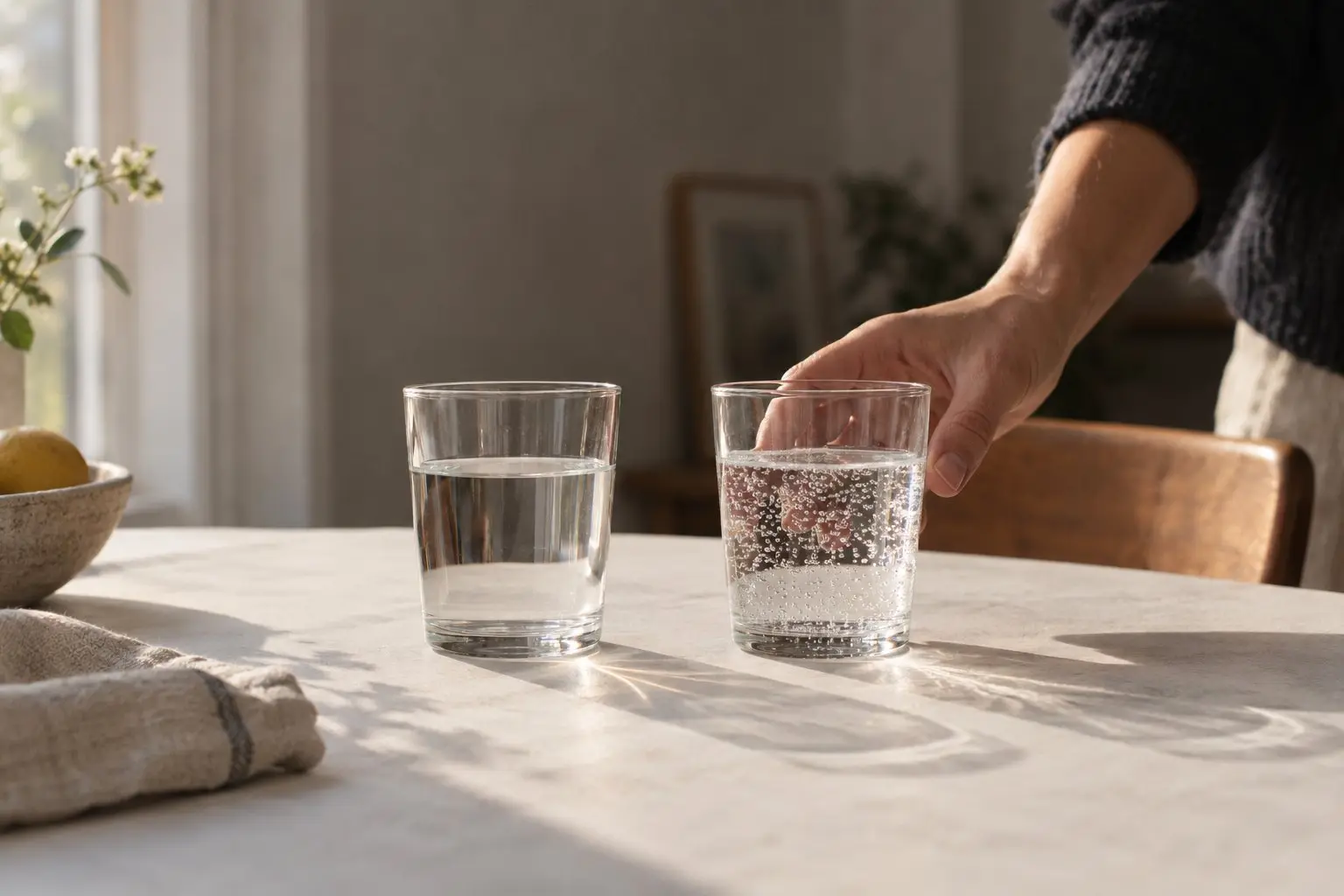
Yes, plain sparkling water hydrates you just as well as still water and is gentle on your teeth. The exception is flavored sparkling water with added fruit acids, which in lab tests attacked tooth enamel about as much as orange juice. If bubbles leave you bloated, that is a reason to choose still water, not a health risk.
Key takeaways
- Plain sparkling water dissolved enamel about a hundred times less than soft drinks in lab tests.
- Your body keeps sparkling water as well as still water.
- Flavored sparkling waters should be treated as acidic drinks, even without sugar.
- In a small trial, sparkling water eased indigestion and constipation.
- Fizzy drinks other than cola showed no link to weaker bones.
Is sparkling water bad for your teeth?
Plain sparkling water hardly harms your teeth. Researchers at the University of Birmingham put extracted human teeth and enamel powder into a range of still and sparkling mineral waters and into soft drinks. Sparkling waters dissolved slightly more enamel than still ones, but the amounts stayed very low, roughly a hundred times lower than with the soft drinks. When they let a sparkling water go flat, it became only a little less erosive, which suggests the bubbles themselves are not the main problem (Parry et al., 2001). Minerals in the water, calcium above all, even seemed to protect the enamel.
Flavored sparkling water is a different drink. The same group later tested flavored sparkling waters from British supermarkets. All of them were clearly acidic and dissolved enamel as much as or more than pure orange juice, a well-known erosive drink (Brown et al., 2007). The fruit acids added for taste do the damage, sugar or no sugar.
These were laboratory tests. In a real mouth, saliva neutralizes acid, and the way you drink matters: in studies of tooth erosion, acidic food and drinks four or more times a day and keeping a drink in the mouth longer went with more damage (Lussi & Jaeggi, 2008). A can sipped over a whole afternoon means many small contacts instead of one, and the lab tests can’t say exactly how much enamel a given habit like that costs in a real mouth with real saliva. The direction is clear, though.
Does sparkling water hydrate you as well as still water?
Yes, sparkling water hydrates you as well as still water. In a trial at Loughborough University, 72 men drank a liter of different drinks on separate days, and the researchers measured how much urine they produced over the next four hours. Sparkling water came out the same as still water. So did coffee, tea and cola; only milk and an oral rehydration solution were retained better (Maughan et al., 2016). The study was funded by the European Hydration Institute, which is worth knowing, although it doesn’t change the sparkling water result.
If the bubbles help you drink more water, that is a plus. How much you need in total is covered in How much water do you really need? Whether you need electrolytes on top of water is in Do you need electrolytes?
Does sparkling water cause bloating?
Sparkling water can cause bloating because you swallow gas, and some people notice that more than others. For people with indigestion, though, it may even help. In a small double-blind trial in Naples, 21 people with functional dyspepsia and constipation drank either carbonated or tap water for about two weeks. With carbonated water, their indigestion and constipation scores improved and their gallbladder emptied better; with tap water, nothing changed (Cuomo et al., 2002). Twenty-one people is very few. Treat it as a hint.
If sparkling water leaves you uncomfortable, or you have reflux and a fizzy glass with dinner makes the evening worse, still water is the better choice, because it does the same job for your body without the gas.
Does sparkling water weaken your bones?
Nothing suggests that sparkling water weakens bones. The worry comes from colas. In the Framingham Osteoporosis Study, women who drank cola daily had lower bone density at the hip than those who rarely did, and that applied to diet cola too. Other carbonated drinks showed no link to bone density at all (Tucker et al., 2006). The researchers suspected ingredients specific to colas, such as phosphoric acid and caffeine, and the healthier drinks that cola replaces. Bubbles alone showed no effect.
What I’d do
- Drink plain sparkling or still water, whichever you’ll actually drink more of.
- Add a slice of lemon or cucumber yourself rather than buying flavored sparkling water every day.
- Drink flavored sparkling water with meals instead of sipping it all afternoon, if you love it.
- Switch to still water if bubbles make you bloated or worsen reflux.
- Keep cola for occasions, since cola, unlike other fizzy drinks, was linked to lower bone density, diet cola included. The diet soda article covers the sweetener question.
Frequently asked questions
Is mineral water healthier than tap water? Not in general. Mineral waters vary a lot in calcium, magnesium and sodium. Calcium-rich waters may even protect enamel slightly (Parry et al., 2001), but safe tap water hydrates you just as well.
Does sparkling water with lime or “essence” count as flavored? If acid is added for flavor, yes. Check the ingredients for citric acid or other fruit acids; that is what made the flavored waters in the study erosive (Brown et al., 2007).
Can a soda maker at home cause problems? Not for your teeth or hydration, as long as you carbonate plain water. Flavor syrups added afterward turn it back into a soft drink.
Sources
- Brown, C. J., Smith, G., Shaw, L., Parry, J., & Smith, A. J. (2007). The erosive potential of flavoured sparkling water drinks. International Journal of Paediatric Dentistry, 17(2), 86–91. https://doi.org/10.1111/j.1365-263x.2006.00784.x
- Cuomo, R., Grasso, R., Sarnelli, G., Capuano, G., Nicolai, E., Nardone, G., Pomponi, D., Budillon, G., & Ierardi, E. (2002). Effects of carbonated water on functional dyspepsia and constipation. European Journal of Gastroenterology & Hepatology, 14(9), 991–999. https://doi.org/10.1097/00042737-200209000-00010
- Lussi, A., & Jaeggi, T. (2008). Erosion: Diagnosis and risk factors. Clinical Oral Investigations, 12(Suppl. 1), S5–S13. https://doi.org/10.1007/s00784-007-0179-z
- Maughan, R. J., Watson, P., Cordery, P. A., Walsh, N. P., Oliver, S. J., Dolci, A., Rodriguez-Sanchez, N., & Galloway, S. D. (2016). A randomized trial to assess the potential of different beverages to affect hydration status: Development of a beverage hydration index. The American Journal of Clinical Nutrition, 103(3), 717–723. https://doi.org/10.3945/ajcn.115.114769 (Funded by the European Hydration Institute.)
- Parry, J., Shaw, L., Arnaud, M. J., & Smith, A. J. (2001). Investigation of mineral waters and soft drinks in relation to dental erosion. Journal of Oral Rehabilitation, 28(8), 766–772. https://doi.org/10.1046/j.1365-2842.2001.00795.x
- Tucker, K. L., Morita, K., Qiao, N., Hannan, M. T., Cupples, L. A., & Kiel, D. P. (2006). Colas, but not other carbonated beverages, are associated with low bone mineral density in older women: The Framingham Osteoporosis Study. The American Journal of Clinical Nutrition, 84(4), 936–942. https://doi.org/10.1093/ajcn/84.4.936