Are fermented foods good for your gut?
What happened when healthy adults ate kimchi, kefir and yogurt every day for weeks, which jars still hold live microbes, and where the salt hides.

Katja Michel, M.Ed. · 5 min read
Probably, but the evidence is younger than the hype. In a small Stanford trial, healthy adults who ate fermented foods several times a day for weeks had a more diverse mix of gut bacteria and lower markers of inflammation. Not every fermented food still contains live microbes, and some are very salty, so the choice of jar matters.
Key takeaways
- A diet rich in yogurt, kefir, kimchi and similar foods increased gut bacteria diversity in a trial with 36 adults, while a high-fiber diet didn’t.
- The trial’s main planned outcome didn’t change, so its findings on inflammation are promising rather than proven.
- Bread, pasteurized sauerkraut and vinegar pickles contain no live microbes, even if they were fermented.
- For yogurt, the FDA allows a claim about lower type 2 diabetes risk but calls the evidence limited.
- Kombucha has almost no human research behind its health claims.
What did the Stanford fermented food study find?
The Stanford trial found more diverse gut bacteria and lower inflammation markers in people who ate fermented foods every day. Researchers randomly assigned 36 healthy adults to a high-fermented-food diet or a high-fiber diet for ten weeks. The fermented food group ate yogurt, kefir, fermented cottage cheese, kimchi and other fermented vegetables, vegetable brine drinks and kombucha (Stanford Medicine, 2021). Their intake rose from well under one serving a day to about six (Trone et al., 2023).
The diversity of their gut bacteria rose steadily, and inflammatory markers in the blood fell. In the fiber group, diversity stayed stable (Wastyk et al., 2021). Of the 93 inflammatory proteins the researchers measured, 19 decreased in the fermented food group, including interleukin 6, and none of those 19 decreased in the fiber group (Stanford Medicine, 2021).
Two limits keep me careful. The trial’s main planned outcome, a score of how immune cells respond, didn’t change in either group, and there were only 18 people per diet (Wastyk et al., 2021). That intake is considerably more than people typically eat, so it is unclear how much of the effect a smaller, everyday amount would bring (Chakraborty et al., 2026). The fiber group simply didn’t show the same changes in ten weeks, and the other reasons fiber matters are laid out in How much fiber do you need a day?
Does every fermented food contain live bacteria?
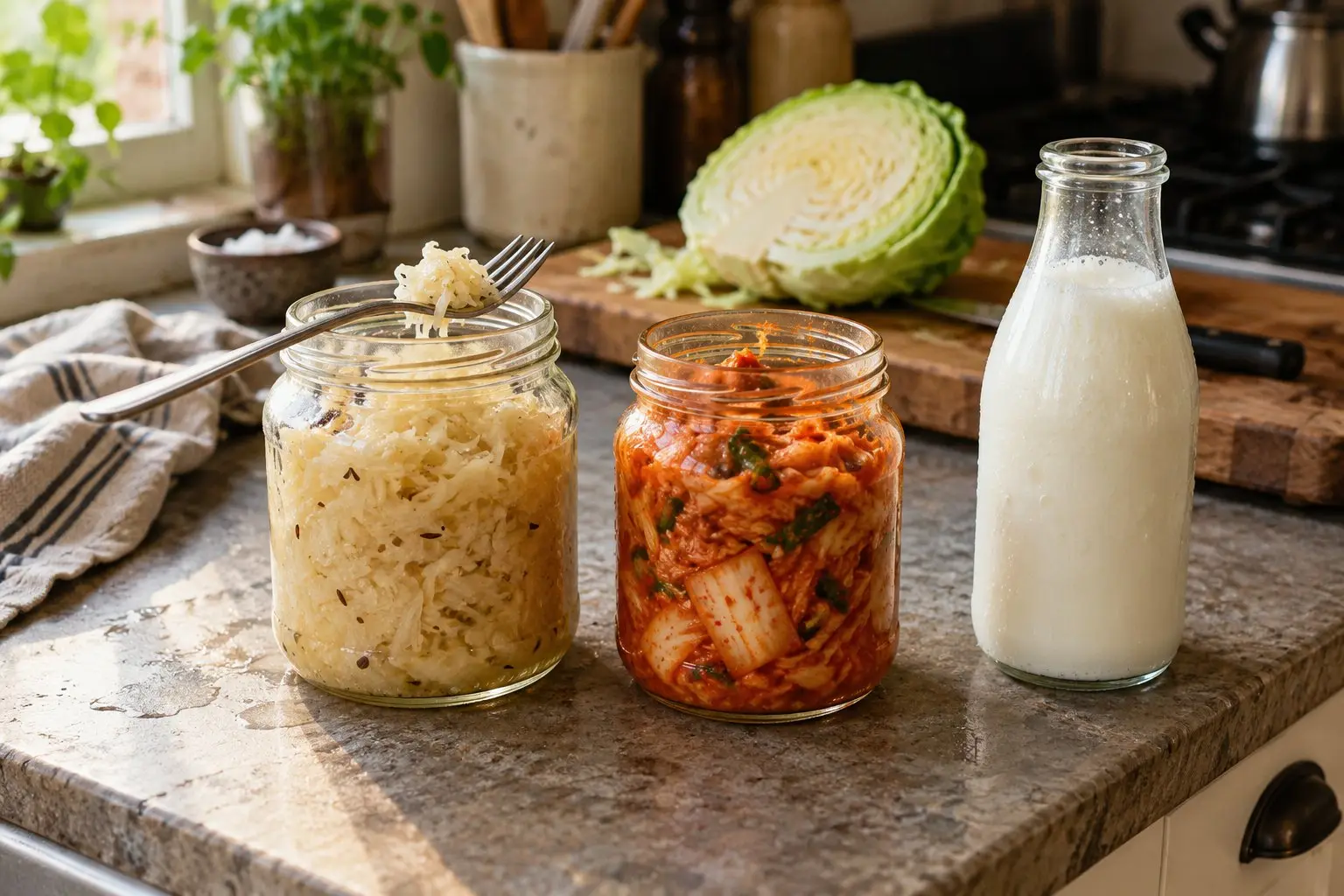
No, and the label often doesn’t tell you. An international expert panel on fermented foods defined them as foods made through desired microbial growth, and then sorted them by whether live microbes survive into the product you eat. Yogurt, kefir, most cheeses, miso, tempeh, unheated fermented vegetables and most kombuchas still contain them. Bread, heat-treated or pasteurized fermented vegetables, soy sauce, vinegar, wine and most beers don’t. Vegetables pickled in vinegar or brine without microbes aren’t fermented at all (Marco et al., 2021).
How to spot the live ones
Labels rarely say it plainly. The panel suggests that pasteurized products without live microbes be labeled as “made by fermentation” (Marco et al., 2021), so words such as “unpasteurized” or “live cultures” are the clue to look for. Several of the panel’s members consult for food and probiotic companies, which they declare in the paper.
Is yogurt good for you?
Yogurt has the most evidence of any fermented food, and it is still described as limited. In 2024 the US Food and Drug Administration allowed yogurt makers to say that eating yogurt regularly, at least two cups (three servings) a week, may reduce the risk of type 2 diabetes. The claim must add that the evidence is limited. Danone North America asked for it (US Food and Drug Administration, 2024).
What about kombucha?
Kombucha’s health claims rest on almost no human research. A systematic review in 2018 went through 310 articles and found only one study that had tested kombucha in people, along with no registered clinical trials (Kapp & Sumner, 2019). It can be a pleasant drink, but the gut claims on the bottle are ahead of the science.
How salty are sauerkraut and kimchi?
Salty enough to count. One cup of canned sauerkraut has about 940 milligrams of sodium and one cup of kimchi about 750 milligrams (U.S. Department of Agriculture, n.d.-a; n.d.-b), against a Daily Value of 2,300 milligrams (Food labeling, 2026). A forkful as a side is a different matter from a bowl, especially if you are working on your blood pressure, where cutting salt is one of the habits with trial evidence.
What I’d do
- Add one fermented food you like to your day, such as plain yogurt, kefir or a spoon of kimchi.
- Look for “unpasteurized” or “live cultures” on sauerkraut and kimchi if you want live microbes.
- Keep the portions of salty ferments small, a few forkfuls rather than a bowl.
- Treat kombucha as a drink you enjoy, not as a health product.
- Keep eating plenty of plants, since vegetables and fruit bring the fiber that feeds the bacteria already there.
Frequently asked questions
Are fermented foods the same as probiotics? No. Traditional sauerkraut probably contains several strains of lactic acid bacteria, but unidentified strains at unknown doses don’t qualify as probiotics, which need characterized strains with shown benefits at an effective dose (Marco et al., 2021). Pills are another matter. The trials on probiotic supplements, which use defined strains and doses, are covered in Do probiotic supplements work?
Is sourdough bread a fermented food? Yes, but baking kills the microbes, so it contains no live cultures (Marco et al., 2021).
Does pasteurized sauerkraut still count as fermented? Yes, it was made by fermentation, but heat treatment leaves it without live microbes, which is why the panel suggests the label “made by fermentation” for such products (Marco et al., 2021).
Sources
- Chakraborty, T., Kashyap, S. J., Chetia, P. D., & Purkayastha, S. (2026). Gut microbiota-mediated biotransformation of dietary bioactive compounds: Inter-individual variability, determinants, and implications for personalised nutrition. Frontiers in Systems Biology, 6, 1898890. https://doi.org/10.3389/fsysb.2026.1898890
- Food labeling, 21 C.F.R. § 101.9 (2026). https://www.law.cornell.edu/cfr/text/21/101.9
- Kapp, J. M., & Sumner, W. (2019). Kombucha: A systematic review of the empirical evidence of human health benefit. Annals of Epidemiology, 30, 66–70. https://doi.org/10.1016/j.annepidem.2018.11.001
- Marco, M. L., Sanders, M. E., Gänzle, M., Arrieta, M. C., Cotter, P. D., De Vuyst, L., et al. (2021). The International Scientific Association for Probiotics and Prebiotics (ISAPP) consensus statement on fermented foods. Nature Reviews Gastroenterology & Hepatology, 18(3), 196–208. https://doi.org/10.1038/s41575-020-00390-5 (Several authors consult for food and probiotic companies.)
- Stanford Medicine. (2021, July 12). Fermented-food diet increases microbiome diversity, decreases inflammatory proteins, study finds. https://med.stanford.edu/news/all-news/2021/07/fermented-food-diet-increases-microbiome-diversity-lowers-inflammation (The study was supported by donations to Stanford’s Center for Human Microbiome Research, among other funders.)
- Trone, K., Rahman, S., Green, C. H., Venegas, C., Martindale, R., & Stroud, A. (2023). Synbiotics and surgery: Can prebiotics and probiotics affect inflammatory surgical outcomes? Current Nutrition Reports, 12(2), 238–246. https://doi.org/10.1007/s13668-023-00464-1
- U.S. Department of Agriculture. (n.d.-a). Sauerkraut, canned, solids and liquids (FoodData Central, FDC ID 169279). https://fdc.nal.usda.gov/food-details/169279/nutrients
- U.S. Department of Agriculture. (n.d.-b). Cabbage, kimchi (FoodData Central, FDC ID 170392). https://fdc.nal.usda.gov/food-details/170392/nutrients
- US Food and Drug Administration. (2024, March 1). FDA announces qualified health claim for yogurt and reduced risk of type 2 diabetes. https://www.fda.gov/food/hfp-constituent-updates/fda-announces-qualified-health-claim-yogurt-and-reduced-risk-type-2-diabetes
- Wastyk, H. C., Fragiadakis, G. K., Perelman, D., Dahan, D., Merrill, B. D., Yu, F. B., et al. (2021). Gut-microbiota-targeted diets modulate human immune status. Cell, 184(16), 4137–4153.e14. https://doi.org/10.1016/j.cell.2021.06.019