Do probiotic supplements work?
The one use where probiotic pills hold up in trials, why they barely change the gut bacteria of healthy adults, and a surprising result after antibiotics.

Katja Michel, M.Ed. · 6 min read
Probiotics during antibiotics
Taking probiotics alongside antibiotics roughly halved the number of people who got diarrhea from the antibiotics.
Share who developed antibiotic-associated diarrhea, probiotic vs control
Probiotic supplements work for one thing with good evidence: they lower the chance of diarrhea when you take antibiotics. For everyday “gut health” in healthy adults, the trials found little, because the pills barely changed the composition of their gut bacteria. And one small study suggests that after a course of antibiotics, probiotics may even slow down the return of your own gut flora.
Key takeaways
- The antibiotic trials tested supplements with defined strains, so their results don’t automatically apply to yogurt or other fermented foods.
- High-dose products worked better against antibiotic-associated diarrhea in children than low-dose ones.
- In seven trials with healthy adults, probiotics didn’t change the diversity of their gut bacteria compared with a placebo.
- Probiotic supplements don’t need FDA approval before they are sold, and some products contained microbes that weren’t on the label.
- People with severe illness, weakened immune systems and premature babies face a higher risk of serious infections from probiotics.
What are probiotics?
Probiotics are living microorganisms that are meant to benefit health when you swallow them. In the trials below, they were usually bacteria from the Lactobacillus or Bifidobacterium groups, or a yeast called Saccharomyces boulardii, alone or in combination (Guo et al., 2019). Most of them are sold as dietary supplements, which don’t require approval from the US Food and Drug Administration before they reach the shelf (National Center for Complementary and Integrative Health, 2019).
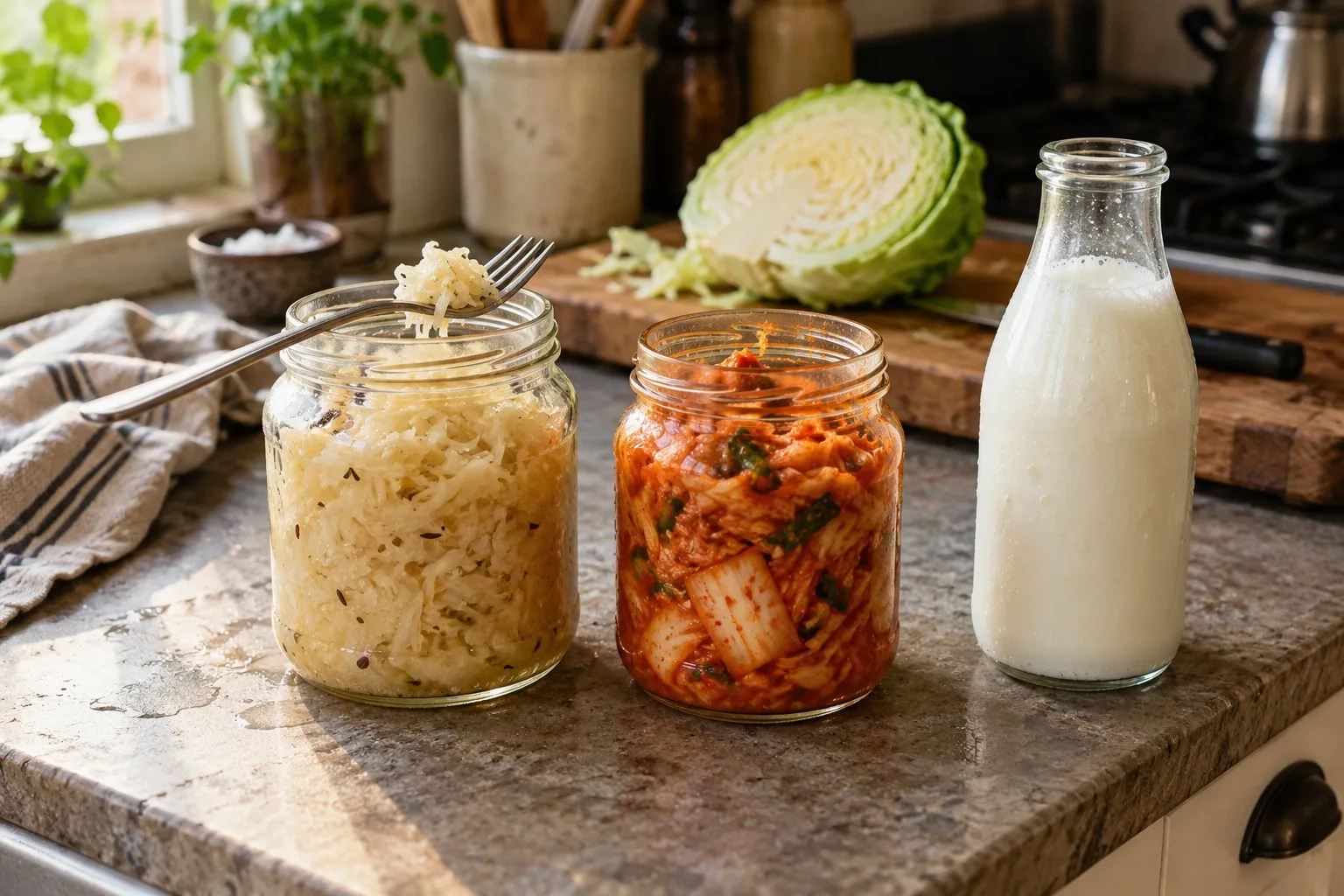
Fermented foods such as yogurt, kefir and sauerkraut contain live microbes too, but they are a different question, with their own trials, which are covered in Are fermented foods good for your gut?
Do probiotics prevent diarrhea from antibiotics?
Yes, and this is the best-supported use. A Cochrane review pooled 33 trials with children who took antibiotics along with either probiotics or a placebo, another treatment or nothing. Probiotics prevented about one case of antibiotic-associated diarrhea for every nine children treated, and the evidence was rated as moderate in certainty. High doses of at least 5 billion colony-forming units a day worked better than lower doses, and the probiotics may have shortened diarrhea by almost a day when it did occur (Guo et al., 2019).
Adults showed a similar pattern. A review of 17 trials with 3,631 outpatients, people treated at home rather than in hospital, found the same roughly halved risk, with similar results for the two most studied strains, Lactobacillus rhamnosus GG and Saccharomyces boulardii (Blaabjerg et al., 2017). Side effects such as gas, bloating, nausea or a rash were uncommon in the children’s trials and no more frequent than in the control groups (Guo et al., 2019).
Do probiotics improve gut health in healthy people?
Probably not: in healthy adults, probiotics haven’t been shown to change the gut bacteria in any measurable way. A systematic review found seven randomized trials that gave healthy adults a probiotic or a placebo and then analyzed their stool bacteria with modern DNA sequencing. None of the trials found a change in the diversity, richness or evenness of the gut bacteria, and only one found a shift in the overall structure of the community. The reviewers concluded that there is a lack of evidence that probiotics change the gut microbiota of healthy adults (Kristensen et al., 2016).
That doesn’t prove probiotics do nothing else in a healthy body, but it removes the main argument on the packaging. The everyday alternative is food: how much fiber you need, and what it does, is explained in How much fiber do you need a day?
Should you take probiotics after antibiotics?
Possibly not for weeks afterward, because one study found that probiotics delayed the return of the gut’s own bacteria. The study published in the journal Cell gave volunteers a course of antibiotics, then either a multi-strain probiotic, a transplant of their own stool collected before the antibiotics, or nothing, and sampled the lining of their gut directly. Compared with letting the gut recover on its own, the probiotics markedly delayed the return of the person’s own bacteria and left it incomplete, while the person’s own stored bacteria restored the gut within days. The researchers saw the same pattern in mice (Suez et al., 2018).
The study was small and measured bacteria, not symptoms, so it doesn’t cancel out the diarrhea trials above. It does suggest that taking probiotics for weeks after a course of antibiotics, “to rebuild the gut”, isn’t the harmless extra it is often sold as.
Are probiotics safe?
For healthy people, probiotics have a long history of apparently safe use, although few studies have looked at safety in detail. The risk of harm is greater for people with severe illnesses or weakened immune systems, and severe or fatal infections have been reported in premature babies given probiotics, which led the FDA to warn doctors. Some products have also been found to contain microorganisms other than those on the label (National Center for Complementary and Integrative Health, 2019).
What I’d do
- Ask your doctor or pharmacist about a probiotic when you start antibiotics, especially if antibiotics have upset your stomach before.
- Skip probiotics as a daily habit for general gut health.
- Feed your own gut bacteria with fiber from vegetables, beans, oats and whole grains.
- Don’t give probiotics to a premature baby, or take them while seriously ill or immunosuppressed, without your doctor’s approval.
Frequently asked questions
Which probiotic strain works best for antibiotic diarrhea? In the reviews above, Lactobacillus rhamnosus GG and Saccharomyces boulardii were the most studied and showed similar results in outpatients (Blaabjerg et al., 2017). The Cochrane reviewers also call for a large trial to confirm the benefit of high-dose products (Guo et al., 2019).
Do probiotics help with bloating or irritable bowel syndrome? The studies discussed here didn’t test irritable bowel syndrome, so they can’t answer that. If bloating or bowel changes are new or persistent, see a doctor before you buy supplements, because the cause matters for the treatment.
Is yogurt enough as a probiotic? Yogurt with live cultures contains bacteria, but the antibiotic trials tested supplements with defined strains and doses, so their results don’t transfer directly to yogurt. Whether fermented foods help your gut in other ways is covered in the fermented foods article linked above.
Sources
- Blaabjerg, S., Artzi, D. M., & Aabenhus, R. (2017). Probiotics for the prevention of antibiotic-associated diarrhea in outpatients: A systematic review and meta-analysis. Antibiotics, 6(4), 21. https://doi.org/10.3390/antibiotics6040021
- Guo, Q., Goldenberg, J. Z., Humphrey, C., El Dib, R., & Johnston, B. C. (2019). Probiotics for the prevention of pediatric antibiotic-associated diarrhea. Cochrane Database of Systematic Reviews, 4, CD004827. https://doi.org/10.1002/14651858.cd004827.pub5
- Kristensen, N. B., Bryrup, T., Allin, K. H., Nielsen, T., Hansen, T. H., & Pedersen, O. (2016). Alterations in fecal microbiota composition by probiotic supplementation in healthy adults: A systematic review of randomized controlled trials. Genome Medicine, 8(1), 52. https://doi.org/10.1186/s13073-016-0300-5
- National Center for Complementary and Integrative Health. (2019, August). Probiotics: Usefulness and safety. https://www.nccih.nih.gov/health/probiotics-usefulness-and-safety
- Suez, J., Zmora, N., Zilberman-Schapira, G., Mor, U., Dori-Bachash, M., Bashiardes, S., et al. (2018). Post-antibiotic gut mucosal microbiome reconstitution is impaired by probiotics and improved by autologous FMT. Cell, 174(6), 1406–1423. https://doi.org/10.1016/j.cell.2018.08.047