Does turmeric actually work?
The spice is fine. The pills are another matter: modest relief for sore knees in small trials, and rare cases of serious liver injury.

Katja Michel, M.Ed. · 6 min read
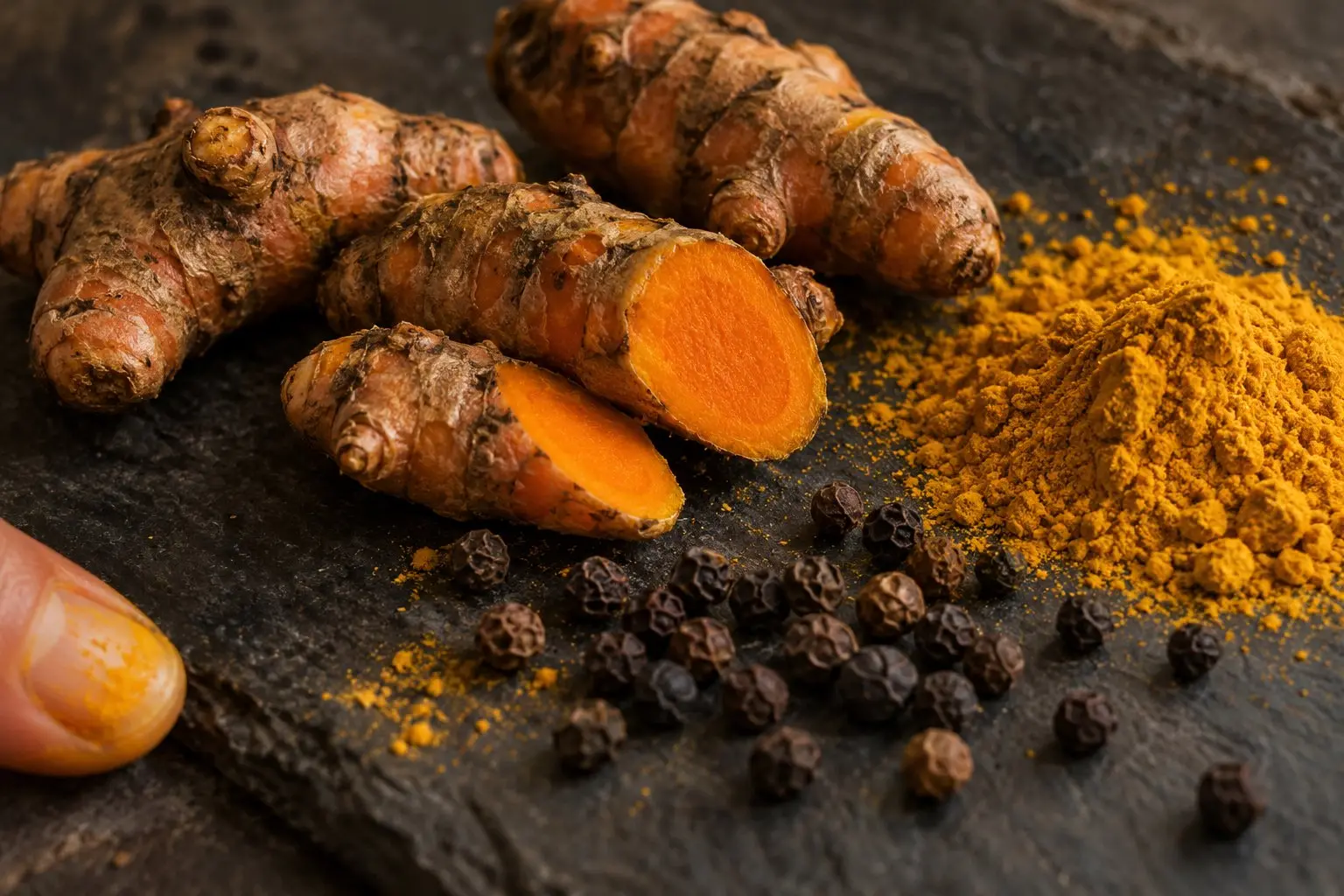
Turmeric is a fine spice, but turmeric supplements have little proof behind them for most of what they promise. The one use with some support is knee osteoarthritis, where extracts eased pain modestly in small, short trials. At the same time, turmeric pills, especially those combined with black pepper extract, have been linked to rare but serious liver injury.
Key takeaways
- Curcumin, the compound most studied in turmeric, is poorly absorbed, unstable and prone to false positive results in laboratory tests.
- Black pepper’s piperine raises curcumin levels in the blood many times over, which is why so many supplements combine the two.
- In a pooled analysis of knee osteoarthritis trials, turmeric extracts eased pain about as well as common anti-inflammatory painkillers.
- A US network that tracks drug-induced liver injury found turmeric cases rising, and most patients carried the same gene variant.
- Turmeric sold in Bangladesh was often colored with a lead pigment until a crackdown that started in 2017.
Why are scientists skeptical about curcumin?
Scientists are skeptical about curcumin because it behaves badly as a drug candidate. Turmeric contains up to about 5 percent curcumin, and a team of medicinal chemists reviewed the evidence on it in 2017. They concluded that curcumin is unstable, reactive and poorly absorbed, and that it belongs to a group of compounds known for producing false positive results in laboratory tests. By their count, more than 120 clinical trials of curcuminoids had been run, and none of the double-blind, placebo-controlled ones had been successful (Nelson et al., 2017).
That is a harsh verdict, and some trials published since have found modest effects, especially for knee pain. It is still the right starting point for any claim on a turmeric label.
Does black pepper help you absorb turmeric?
Black pepper helps you absorb curcumin, at least for a short time. In a study with healthy volunteers, 2 grams of curcumin alone produced blood levels that were undetectable or very low. When the volunteers took 20 milligrams of piperine, the active compound in black pepper, with the curcumin, its bioavailability rose by 2,000 percent, mostly within the first hour (Shoba et al., 1998). The boost is short-lived.
Liver specialists have started to look at that pepper combination for a different reason, as the liver section below shows.
Does turmeric help with joint pain?
Turmeric extracts help with knee osteoarthritis pain, but only modestly. In a trial in Tasmania, 70 people with painful knee osteoarthritis and fluid in the joint took two capsules of a turmeric extract or a placebo daily for twelve weeks. The turmeric group’s knee pain improved by about 9 points more on a 100-point scale, but the swelling in the joint and the cartilage on MRI didn’t change. The authors call for larger trials to judge whether the effect matters clinically, and the trial was funded by the University of Tasmania and by the company Natural Remedies Private Limited (Wang et al., 2020). A later analysis from the same trial found no change in inflammation markers in the blood (Wang et al., 2023).
A meta-analysis of 16 trials with 1,810 adults with knee osteoarthritis found that turmeric extracts eased pain and improved function more than a placebo and about as much as anti-inflammatory painkillers, with fewer side effects than those drugs. The trials lasted up to 16 weeks, differed a lot from each other and had a moderate risk of bias, and turmeric helped less in people with a higher body weight (Wang et al., 2021).
Strength training remains the better-tested habit for joints, and the weekly minimum for strength training is smaller than most plans suggest. Another supplement sold on similar promises gets the same scrutiny in are fish oil supplements worth taking.
Can turmeric supplements damage your liver?
Turmeric supplements can damage the liver, rarely, but the risk is real and seems to be growing. The US Drug-Induced Liver Injury Network reviewed all its cases from 2004 to 2022 and found ten in which turmeric was implicated, all since 2011 and six since 2017. Five patients were hospitalized. One died of acute liver failure. Every product the researchers could test contained turmeric, and three of the seven also contained piperine. Seven of the ten patients carried a gene variant called HLA-B*35:01, which is far less common in the general population, and the injury typically appeared one to four months after starting the supplement (Halegoua-DeMarzio et al., 2023).
The authors suspect that the rising numbers reflect more people taking turmeric products, more often combined with black pepper.
What I’d do
- Cook with turmeric as much as you like; it gives curries, rice and soups their color and warmth.
- Skip turmeric supplements for vague goals such as “inflammation” or “immunity”; the trials on ginger, a related spice, are also stronger for nausea than for inflammation.
- Talk to your doctor before trying a turmeric extract for knee pain, especially if you take other medicines.
- Stop a turmeric supplement and see a doctor if your skin or eyes turn yellow or you get pain under your right ribs.
Frequently asked questions
Can turmeric contain lead? It has in some countries. In Bangladesh, turmeric was often polished with lead chromate, a yellow pigment, and identified as a major source of lead exposure. After a campaign with the national food safety authority, the share of market samples with detectable lead fell from 47 percent in 2019 to zero in 2021 (Forsyth et al., 2023). Buy spices from sellers you trust.
How much turmeric is in a curry? I found no reliable measurement for a typical dish, and the amounts vary widely between recipes. The knee trials used concentrated extracts in capsules, so a curry isn’t a substitute for them.
Does turmeric help with depression or memory? The studies discussed here didn’t test mood or memory, so I can’t answer from them. Given the chemists’ verdict above, I would want to see large, independent trials before taking turmeric for either.
Sources
- Forsyth, J. E., Baker, M., Nurunnahar, S., Islam, S., Islam, M. S., Islam, T., et al. (2023). Food safety policy enforcement and associated actions reduce lead chromate adulteration in turmeric across Bangladesh. Environmental Research, 232, 116328. https://doi.org/10.1016/j.envres.2023.116328
- Halegoua-DeMarzio, D., Navarro, V., Ahmad, J., Avula, B., Barnhart, H., Barritt, A. S., et al. (2023). Liver injury associated with turmeric: A growing problem: Ten cases from the Drug-Induced Liver Injury Network [DILIN]. The American Journal of Medicine, 136(2), 200–206. https://doi.org/10.1016/j.amjmed.2022.09.026
- Nelson, K. M., Dahlin, J. L., Bisson, J., Graham, J., Pauli, G. F., & Walters, M. A. (2017). The essential medicinal chemistry of curcumin. Journal of Medicinal Chemistry, 60(5), 1620–1637. https://doi.org/10.1021/acs.jmedchem.6b00975
- Shoba, G., Joy, D., Joseph, T., Majeed, M., Rajendran, R., & Srinivas, P. S. (1998). Influence of piperine on the pharmacokinetics of curcumin in animals and human volunteers. Planta Medica, 64(4), 353–356. https://doi.org/10.1055/s-2006-957450
- Wang, Z., Jones, G., Winzenberg, T., Cai, G., Laslett, L. L., Aitken, D., et al. (2020). Effectiveness of Curcuma longa extract for the treatment of symptoms and effusion-synovitis of knee osteoarthritis: A randomized trial. Annals of Internal Medicine, 173(11), 861–869. https://doi.org/10.7326/m20-0990 (Funded by the University of Tasmania and Natural Remedies Private Limited.)
- Wang, Z., Singh, A., Jones, G., Winzenberg, T., Ding, C., Chopra, A., et al. (2021). Efficacy and safety of turmeric extracts for the treatment of knee osteoarthritis: A systematic review and meta-analysis of randomised controlled trials. Current Rheumatology Reports, 23(2), 11. https://doi.org/10.1007/s11926-020-00975-8
- Wang, Z., Winzenberg, T., Singh, A., Aitken, D., Blizzard, L., Boesen, M., et al. (2023). Effect of Curcuma longa extract on serum inflammatory markers and MRI-based synovitis in knee osteoarthritis: Secondary analyses from the CurKOA randomised trial. Phytomedicine, 109, 154616. https://doi.org/10.1016/j.phymed.2022.154616