Is organic food healthier?
What reviews of hundreds of food studies found, how much pesticide is left on ordinary produce after a rinse, and why two big cancer studies disagree.

Katja Michel, M.Ed. · 6 min read
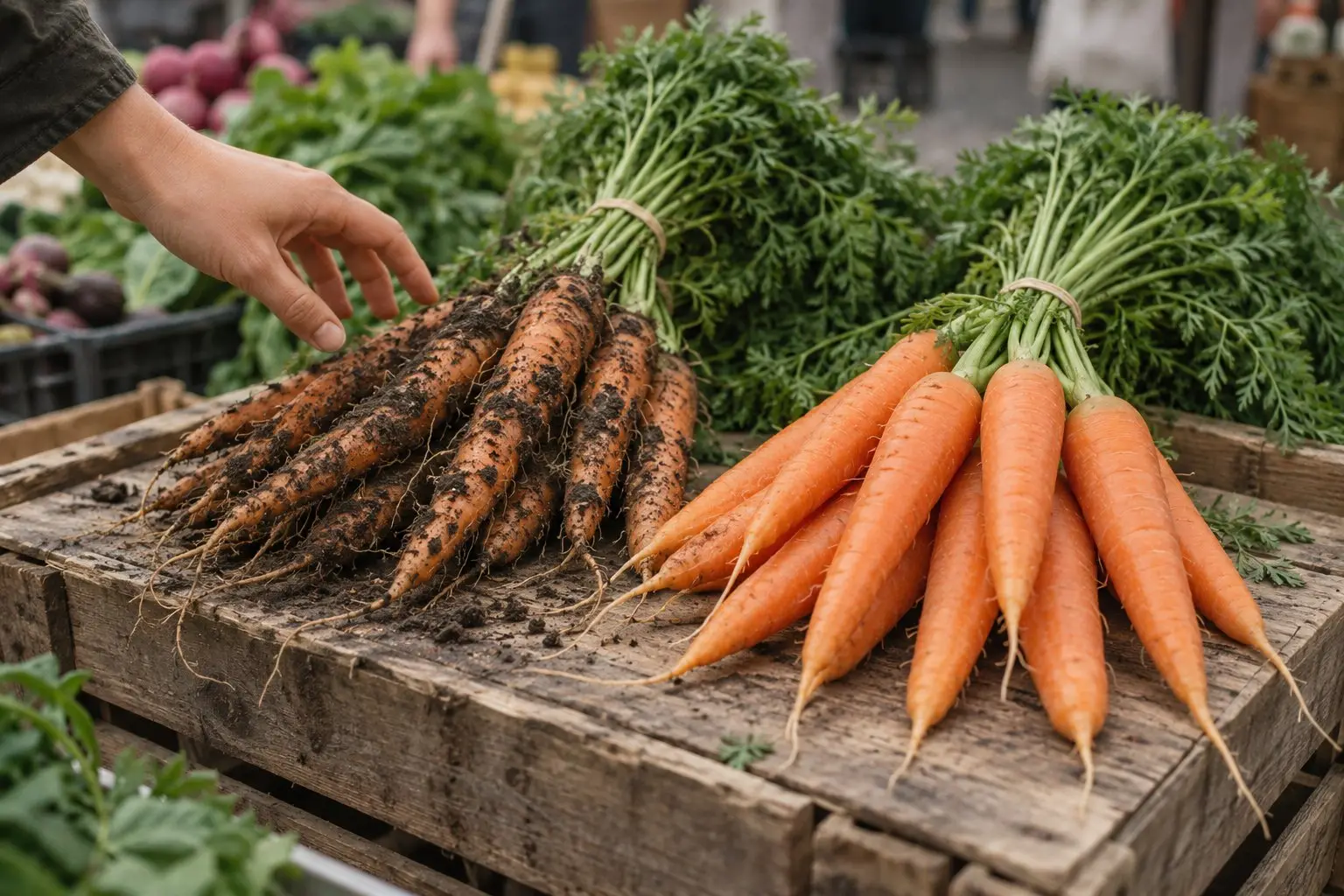
Organic food isn’t clearly more nutritious, and no strong study has shown that eating it makes people healthier. It does carry pesticide residues less often, and people who switch to an organic diet excrete fewer pesticides in their urine, but residues on conventional produce in the United States stayed within legal limits in nearly every sample tested. Eating more fruit and vegetables matters far more than the label on them.
Key takeaways
- Two large reviews disagree on nutrients: one found no meaningful differences, the other found more antioxidants and less cadmium in organic crops.
- Organic produce was less likely to carry detectable pesticide residues, while the chance of exceeding legal limits differed little.
- A French study found less cancer among people who ate organic food often, but a British study of more than half a million women found no such link.
- Conventional chicken and pork more often carried bacteria resistant to several antibiotics.
- Organic farming isn’t pesticide-free: US organic rules allow a list of approved substances, such as copper sulfate.
Is organic food more nutritious?
Not in a way that clearly matters for health, although the reviews disagree on details. One review analyzed 223 studies comparing the nutrient and contaminant levels of organic and conventional foods, plus 17 studies in people, and concluded that the published research lacks strong evidence that organic foods are significantly more nutritious. Phosphorus was slightly higher in organic produce, a difference too small to matter (Smith-Spangler et al., 2012).
A later review of 343 publications came to a different conclusion. It found substantially higher concentrations of several groups of antioxidants in organic crops, for example about 50 percent more flavonols and anthocyanins, lower concentrations of the toxic metal cadmium, and pesticide residues four times more often in conventional crops (Barański et al., 2014). That review was funded by the European Union and by the Sheepdrove Trust, which supports organic and sustainable farming, and its senior author owns both conventionally and organically farmed land.
Both reviews measured what is in the food. Neither shows that the differences change anyone’s health, which is the question most shoppers actually have.
Does eating organic lower your pesticide exposure?
Yes, eating organic food lowers your pesticide exposure in the short term and in measurable amounts. In a small US study, four families with 16 people collected urine before and after switching to an organic diet. Levels of 13 pesticides and their breakdown products fell, among them a breakdown product of the insecticide malathion, which dropped by 95 percent (Hyland et al., 2019). The earlier review found lower pesticide levels in the urine of children on organic diets in two studies (Smith-Spangler et al., 2012).
Lower exposure is real. Whether it changes health at the levels found in food is the open question, and these studies didn’t measure any health outcome.
How much pesticide is left on ordinary produce?
Very little that exceeds the legal limits. The US Department of Agriculture’s Pesticide Data Program tested 9,832 samples of fruit, vegetables and nuts in 2023. More than 99 percent had residues below the tolerances set by the Environmental Protection Agency, and 38.8 percent had no detectable residue at all. Residues above the tolerance turned up in 48 samples, 39 of them imported. Before testing, the analysts rinsed each sample for 15 to 20 seconds under gently running cold water, the way a shopper might at home (U.S. Department of Agriculture, 2024).
A tolerance is a legal maximum, so a residue below it isn’t automatically harmless and one above it isn’t automatically dangerous. But the data don’t support the idea that conventional produce is soaked in chemicals, and the comparison of frozen and fresh vegetables in Are frozen vegetables as healthy as fresh? shows how much the nutrients themselves depend on storage time instead.
Does organic food lower your risk of cancer?
The two largest studies on organic food and cancer point in opposite directions. In the French NutriNet-Santé cohort, 68,946 adults, most of them women, reported how often they ate 16 organic products and were followed between 2009 and 2016. Those with the highest organic food scores developed cancer 25 percent less often than those with the lowest, an absolute difference of 0.6 percentage points (Baudry et al., 2018).
The Million Women Study in the United Kingdom followed 623,080 middle-aged women for 9.3 years. Women who usually or always ate organic food didn’t have less cancer overall than women who never did; their breast cancer risk was slightly higher, and only non-Hodgkin lymphoma was less common (Bradbury et al., 2014).
Both are observational. Frequent organic eaters may differ from other people in ways a questionnaire can’t fully capture, and the French authors themselves write that the findings need confirming before anyone can say what lies behind them (Baudry et al., 2018). The much larger British study argues against a strong protective effect.
Is organic meat safer?
Organic meat was less likely to carry antibiotic-resistant bacteria, but not less likely to carry bacteria in general. In the 2012 review, bacterial contamination of retail chicken and pork was common and unrelated to the farming method, while the risk of finding bacteria resistant to three or more antibiotics was 33 percentage points higher in conventional chicken and pork (Smith-Spangler et al., 2012). Either way, cooking meat thoroughly and keeping raw meat away from other food stays the main protection.
What I’d do
- Buy as much fruit and vegetables as your budget allows, organic or not.
- Rinse produce under running water before eating it, whatever the label says.
- Buy organic where it matters to you and your budget allows, for example for foods you eat daily, and don’t worry about the rest.
- Handle all raw chicken and pork as if it carried bacteria, and cook it through.
Frequently asked questions
Do organic farmers use pesticides? Yes, but from a restricted list. US organic rules name the synthetic substances allowed in organic crop production, including copper sulfate and potassium bicarbonate for plant diseases (Synthetic substances allowed for use in organic crop production, 2026).
Should I wash organic produce? Yes. In the 2012 review, the risk of E. coli contamination didn’t differ between organic and conventional produce (Smith-Spangler et al., 2012).
Is organic food better for children? Children on organic diets had lower pesticide levels in their urine in two studies, while the three studies in the review that looked at health outcomes, such as eczema and wheezing, found no difference (Smith-Spangler et al., 2012). For children too, eating enough fruit and vegetables comes first; How many vegetables and fruits a day do you really need? has the amounts.
Sources
- Barański, M., Srednicka-Tober, D., Volakakis, N., Seal, C., Sanderson, R., Stewart, G. B., et al. (2014). Higher antioxidant and lower cadmium concentrations and lower incidence of pesticide residues in organically grown crops: A systematic literature review and meta-analyses. British Journal of Nutrition, 112(5), 794–811. https://doi.org/10.1017/s0007114514001366 (Funded by the European Union and the Sheepdrove Trust, which supports organic farming; the senior author owns organically and conventionally farmed land.)
- Baudry, J., Assmann, K. E., Touvier, M., Allès, B., Seconda, L., Latino-Martel, P., et al. (2018). Association of frequency of organic food consumption with cancer risk: Findings from the NutriNet-Santé prospective cohort study. JAMA Internal Medicine, 178(12), 1597–1606. https://doi.org/10.1001/jamainternmed.2018.4357
- Bradbury, K. E., Balkwill, A., Spencer, E. A., Roddam, A. W., Reeves, G. K., Green, J., et al. (2014). Organic food consumption and the incidence of cancer in a large prospective study of women in the United Kingdom. British Journal of Cancer, 110(9), 2321–2326. https://doi.org/10.1038/bjc.2014.148
- Hyland, C., Bradman, A., Gerona, R., Patton, S., Zakharevich, I., Gunier, R. B., & Klein, K. (2019). Organic diet intervention significantly reduces urinary pesticide levels in U.S. children and adults. Environmental Research, 171, 568–575. https://doi.org/10.1016/j.envres.2019.01.024
- Smith-Spangler, C., Brandeau, M. L., Hunter, G. E., Bavinger, J. C., Pearson, M., Eschbach, P. J., et al. (2012). Are organic foods safer or healthier than conventional alternatives? A systematic review. Annals of Internal Medicine, 157(5), 348–366. https://doi.org/10.7326/0003-4819-157-5-201209040-00007
- Synthetic substances allowed for use in organic crop production, 7 C.F.R. § 205.601 (2026). https://www.law.cornell.edu/cfr/text/7/205.601
- U.S. Department of Agriculture, Agricultural Marketing Service. (2024). Pesticide Data Program annual summary, calendar year 2023. https://www.ams.usda.gov/sites/default/files/media/2023PDPAnnualSummary.pdf