Is sourdough bread healthier than regular bread?
What eighteen blood sugar trials found, why an Israeli bread study split its volunteers down the middle, and what “sourdough” on a US label can hide.

Katja Michel, M.Ed. · 5 min read
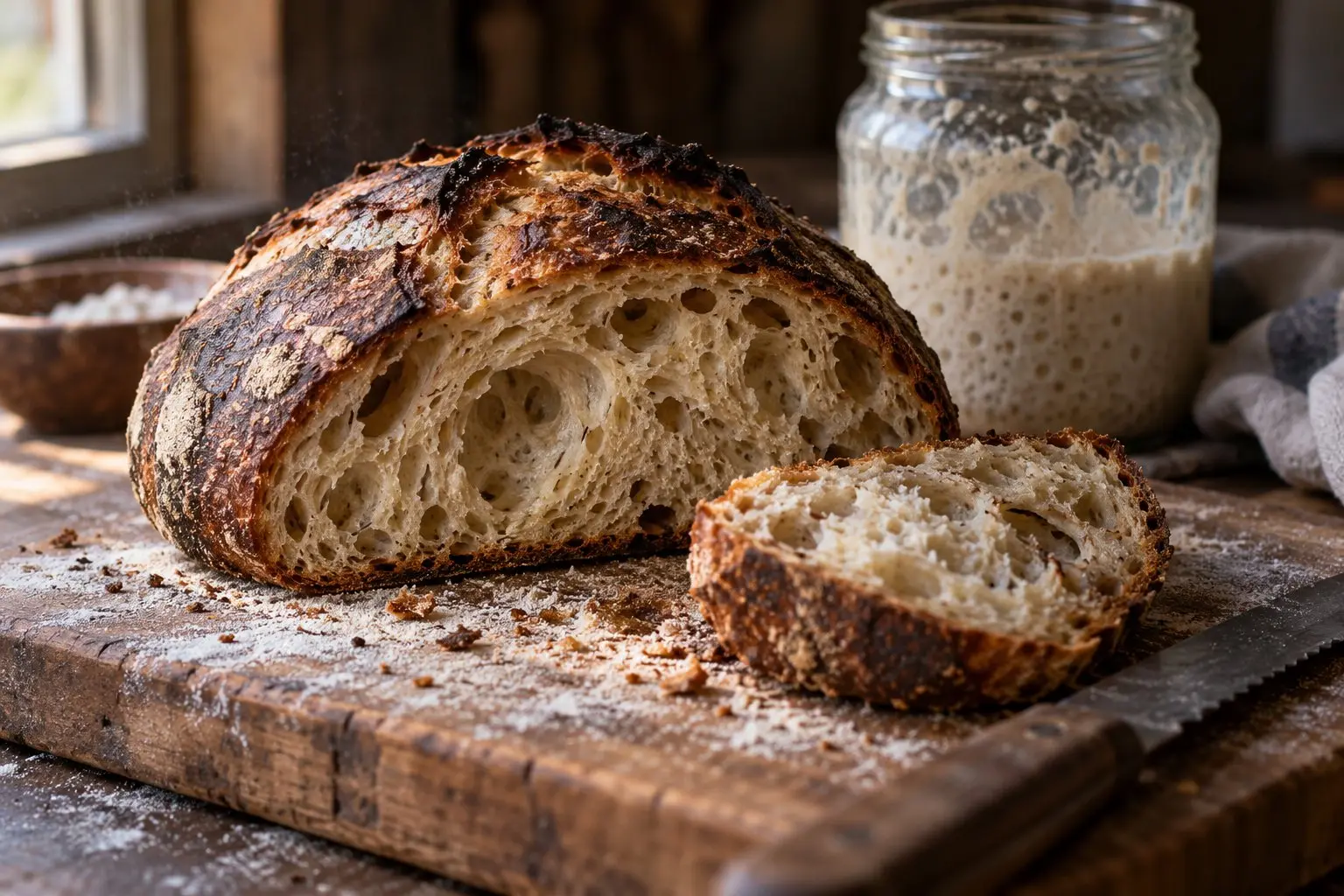
Sourdough bread is a little kinder to your blood sugar than ordinary yeast bread, especially when it is made with whole wheat flour, but the difference in trials was small and the evidence is weak. In a carefully run crossover study, white bread and whole-grain sourdough had the same average effects on health markers over a week, while individual people reacted very differently. Sourdough made from wheat still contains plenty of gluten, so it isn’t safe for people with celiac disease.
Key takeaways
- Sourdough is leavened by wild yeasts and lactic acid bacteria, which make the dough acidic and give the bread its sour taste.
- In pooled trials, blood sugar rose slightly less after sourdough than after industrial bread, with the clearest effect for whole wheat versions.
- People in an Israeli trial split roughly in half: some reacted more to the white bread, the rest more to the sourdough.
- Wheat sourdough from artisan bakeries tested far above the US limit for “gluten-free” labeling.
- The US federal standard for bread doesn’t define sourdough, so the word on the package doesn’t tell you how the loaf was made.
What makes sourdough different?
Sourdough rises with a starter, a culture of wild yeasts and lactic acid bacteria, instead of only baker’s yeast. The bacteria make the dough acidic during a long fermentation, which gives the bread its taste and is the reason researchers have tested whether sourdough raises blood sugar more slowly than other bread (Rolim et al., 2024).
The flour matters at least as much as the fermentation. A white sourdough is still made from refined flour, and a whole wheat loaf, sourdough or not, brings the fiber that How much fiber do you need a day? explains in grams.
Does sourdough raise blood sugar less?
Sourdough raises blood sugar slightly less than other bread in the trials so far. A systematic review pooled 18 clinical trials in adults that compared sourdough bread with industrially fermented bread or with a glucose drink. An hour after eating, blood sugar was 0.29 millimoles per liter lower with sourdough, about 5 milligrams per deciliter, and the difference was a little smaller after two hours. The effect was clearest for sourdough made with whole wheat flour. Fasting insulin didn’t change, and the reviewers rated the certainty of the evidence as low to very low (Rolim et al., 2024).
That is a small difference after a meal. For a sense of scale, the effect of moving after a meal is measured in Does a short walk after eating lower blood sugar?
Is sourdough healthier for everyone?
Sourdough isn’t necessarily healthier for everyone, and a trial from Israel shows why averages can mislead. Researchers at the Weizmann Institute of Science gave 20 healthy adults large amounts of bread, about a quarter of their calories, for one week: either industrial white bread made from refined wheat, or sourdough from an artisan bakery made with freshly stone-milled whole grain flour. After a two-week break without bread, the groups switched. On average, the two breads had the same effects on a long list of clinical measures, and the researchers wrote that they found no difference between the health effects of the two breads (Weizmann Institute of Science, 2017).
Underneath the average, people differed sharply. About half had a higher blood sugar response to the white bread and the other half to the sourdough, and the team could predict who would react to which bread from each person’s gut bacteria before the trial began (Korem et al., 2017). The study was small and lasted a week, so it can’t say anything about years of eating one bread or the other. It does suggest that sourdough isn’t automatically the better bread for your body in particular.
Is sourdough bread gluten-free?
No, sourdough bread isn’t gluten-free. Wheat sourdough contains gluten, and the long fermentation doesn’t remove enough of it to make the bread safe for people with celiac disease. In the United States, a food labeled gluten-free must contain less than 20 parts per million of gluten (Gluten-free labeling of foods, 2026). When the testing service Gluten Free Watchdog analyzed three artisan sourdough breads, one contained 104,000 parts per million of intact gluten and the other two exceeded the upper limit of the tests (Thompson, 2018).
Some people without celiac disease say sourdough sits better in their stomach. That fits the idea that fermentation changes the dough, but the trials above didn’t test digestive comfort, so I can’t tell you whether it holds.
How can you tell if bread is real sourdough?
You have to read the ingredient list, because the word on the front tells you little. The US federal standard for bread describes yeast-leavened dough and simply lists lactic-acid-producing bacteria among the optional ingredients; the word “sourdough” doesn’t appear in it (Bread, rolls, and buns, 2026).
A traditionally made sourdough usually lists little more than flour, water, salt and a starter, sometimes called a levain or culture. If baker’s yeast appears as a separate ingredient near the top, the loaf probably rose mainly the quick way.
What I’d do
- Choose whole grain bread first and treat sourdough as a bonus, not the main criterion.
- Buy sourdough because you like it, and read the ingredient list to see whether it was fermented with a starter.
- Pair bread with protein, fat or vegetables, which matters more for your blood sugar than the bread’s name.
- Avoid wheat and rye sourdough completely if you have celiac disease, and buy only bread labeled gluten-free.
Frequently asked questions
Is sourdough better for people with diabetes? The pooled trials mostly tested blood sugar after a single meal, and the effect was small and uncertain (Rolim et al., 2024). If you have diabetes, ask your doctor or diabetes educator how bread fits your plan, and test your own response if you use a glucose monitor.
Does cooling bread lower its effect on blood sugar? The bread trials above didn’t test cooling. Cooling and reheating changes some of the starch in foods such as pasta, rice and potatoes, and what those studies found is covered in Does cooling pasta, rice or potatoes lower your blood sugar?
Is gluten-free sourdough a thing? Yes, bakers make sourdough from gluten-free flours such as rice, buckwheat or sorghum with a gluten-free starter. For people with celiac disease, the label matters more than the method: only bread labeled gluten-free has to meet the 20 parts per million limit.
Sources
- Bread, rolls, and buns, 21 C.F.R. § 136.110 (2026). https://www.ecfr.gov/current/title-21/chapter-I/subchapter-B/part-136/section-136.110
- Gluten-free labeling of foods, 21 C.F.R. § 101.91 (2026). https://www.law.cornell.edu/cfr/text/21/101.91
- Korem, T., Zeevi, D., Zmora, N., Weissbrod, O., Bar, N., Lotan-Pompan, M., et al. (2017). Bread affects clinical parameters and induces gut microbiome-associated personal glycemic responses. Cell Metabolism, 25(6), 1243–1253. https://doi.org/10.1016/j.cmet.2017.05.002
- Rolim, M. E., Fortes, M. I., Von Frankenberg, A., & Duarte, C. K. (2024). Consumption of sourdough bread and changes in the glycemic control and satiety: A systematic review. Critical Reviews in Food Science and Nutrition, 64(3), 801–816. https://doi.org/10.1080/10408398.2022.2108756
- Thompson, T. (2018, February 19). Sourdough wheat bread is NOT safe for folks with celiac disease. Gluten Free Watchdog. https://www.glutenfreewatchdog.org/news/sourdough-wheat-bread-is-not-safe-for-folks-with-celiac-disease/
- Weizmann Institute of Science. (2017, June 7). Bread and health: A personal matter. https://wis-wander.weizmann.ac.il/node/8711