Are raw vegetables healthier than cooked?
Why a cooked tomato beats a raw one, why raw broccoli wins its own contest, and what happened to people who ate almost nothing but raw food.

Katja Michel, M.Ed. · 5 min read
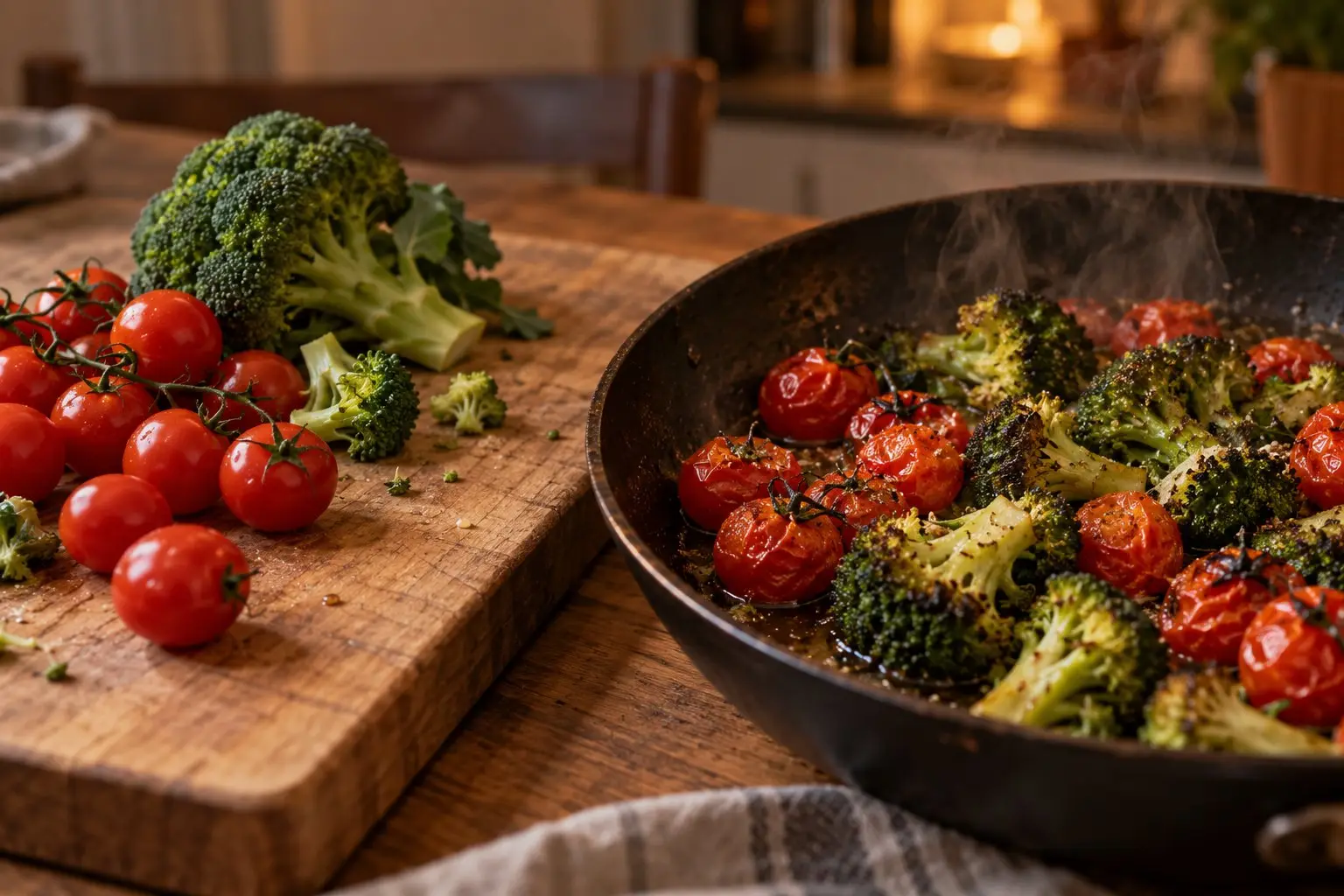
Neither raw nor cooked vegetables are healthier across the board, because heat destroys some nutrients and releases others. Cooking frees much more of the red pigment lycopene in tomatoes and the beta-carotene in carrots, while raw broccoli delivers far more of its best-known plant compound and vitamin C survives better without heat. Eating vegetables both ways, and steaming more often than boiling or frying, covers most of the gains.
Key takeaways
- Heat softens plant tissue, which can make some compounds easier to extract and absorb.
- Vitamin C was the clearest loser when tomatoes were heated.
- Steaming kept more of broccoli’s nutrients than any other home cooking method in a laboratory comparison.
- In Germany, most people on a strict long-term raw food diet had low blood levels of lycopene, and many lacked vitamin B12.
- The amount of vegetables you eat matters more than the method, so cook them in whatever way makes you eat more.
What does cooking do to vegetables?
Cooking softens the plant’s tissue and changes its chemistry, and the net effect depends on the vegetable and the nutrient. A lab study boiled, steamed or fried three vegetables (carrots, zucchini and broccoli) and found that the total antioxidant capacity rose in all the cooked vegetables, probably because the softer tissue released more compounds. Boiling and steaming preserved antioxidant compounds better than frying, especially carotenoids, the yellow and orange pigments. The authors wrote that their findings defy the idea that processed vegetables are less nutritious (Miglio et al., 2008).
What heat did in four studies
| Vegetable and nutrient | Raw | Cooked | Study |
|---|---|---|---|
| Tomato, trans-lycopene (mg per g) | 2.01 | 5.32 after 30 min at 88 °C | Dewanto et al., 2002 |
| Tomato, vitamin C (µmol per g) | 0.76 | 0.54 after 30 min at 88 °C | Dewanto et al., 2002 |
| Broccoli, sulforaphane absorbed | 37% | 3.4% | Vermeulen et al., 2008 |
| Carrots and spinach, rise in blood beta-carotene | 1× | about 3× (not statistically clear) | Rock et al., 1998 |
Values from the cited studies; the tomato study measured food in the lab, the other two measured blood or urine in small groups of volunteers.
Why are cooked tomatoes better than raw?
Cooked tomatoes beat raw ones for lycopene, because heat makes this red pigment more available. When researchers heated tomatoes to 88 degrees Celsius, the amount of usable trans-lycopene rose steeply within 15 minutes and the total antioxidant activity went up, while vitamin C fell with every minute of heating (Dewanto et al., 2002). A tomato sauce therefore trades some vitamin C for considerably more lycopene, which is a good deal for a food you probably don’t eat for its vitamin C.
Carrots and spinach behave similarly with beta-carotene. In a small crossover study, eight healthy women ate the same daily amount of beta-carotene from raw carrots and spinach or from the same vegetables heat-processed and pureed for four weeks each. Blood beta-carotene rose clearly with the processed vegetables and only tended to rise with the raw ones, although the difference between the two periods fell just short of statistical significance (Rock et al., 1998).
Is raw broccoli healthier than cooked?
Raw broccoli is healthier than cooked for sulforaphane, the compound broccoli is famous for. In a crossover trial, eight men ate 200 grams of crushed broccoli, raw or cooked, with a warm meal. Raw broccoli delivered about ten times as much sulforaphane into the blood and urine as cooked broccoli, and it arrived faster (Vermeulen et al., 2008).
How you cook broccoli matters too. A laboratory comparison of five home cooking methods found that steaming kept the vitamin C and the glucosinolates, the parent compounds of sulforaphane, while every other method, including boiling and microwaving, caused significant losses (Yuan et al., 2009).
Is a raw food diet healthier?
A raw food diet wasn’t healthier in the one group that has been measured carefully. Researchers examined 198 people in Germany who had eaten a strict raw food diet for a long time, about 95 percent of their food raw and mostly fruit. Most had normal vitamin A levels, but 77 percent had lycopene levels below the reference values for healthy populations (Garcia et al., 2008). In a related study of 201 raw food eaters in Germany, 38 percent were deficient in vitamin B12, and 46 percent had low HDL cholesterol, although their LDL cholesterol and triglycerides looked favorable (Koebnick et al., 2005).
These are snapshots of one community, so they can’t show what the diet does over time. They do show that “raw” and “nutrient-rich” aren’t the same thing.
What I’d do
- Eat tomatoes cooked, in a sauce or a soup, as often as raw.
- Eat broccoli raw or lightly steamed now and then instead of always boiled.
- Steam vegetables when you can, and use the cooking water in soups or sauces when you boil them.
- Add a little oil to cooked vegetables, since carotenoid levels in the raw food study tracked fat intake.
- Count every portion, raw or cooked, toward your daily vegetable and fruit target
Frequently asked questions
Does microwaving destroy nutrients? In the broccoli comparison, microwaving caused significant losses of vitamin C and other compounds, much like boiling, while steaming kept them (Yuan et al., 2009).
Are frozen vegetables cooked? Frozen vegetables are their own question, and how their vitamins compare with fresh vegetables after a week in the fridge has its own article.
Is it better to eat salad or cooked vegetables? Both count. Raw vegetables keep more vitamin C and compounds like sulforaphane, while cooked ones release more lycopene and beta-carotene, so a mix covers both.
Sources
- Dewanto, V., Wu, X., Adom, K. K., & Liu, R. H. (2002). Thermal processing enhances the nutritional value of tomatoes by increasing total antioxidant activity. Journal of Agricultural and Food Chemistry, 50(10), 3010–3014. https://doi.org/10.1021/jf0115589
- Garcia, A. L., Koebnick, C., Dagnelie, P. C., Strassner, C., Elmadfa, I., Katz, N., et al. (2008). Long-term strict raw food diet is associated with favourable plasma beta-carotene and low plasma lycopene concentrations in Germans. British Journal of Nutrition, 99(6), 1293–1300. https://doi.org/10.1017/s0007114507868486
- Koebnick, C., Garcia, A. L., Dagnelie, P. C., Strassner, C., Lindemans, J., Katz, N., et al. (2005). Long-term consumption of a raw food diet is associated with favorable serum LDL cholesterol and triglycerides but also with elevated plasma homocysteine and low serum HDL cholesterol in humans. The Journal of Nutrition, 135(10), 2372–2378. https://doi.org/10.1093/jn/135.10.2372
- Miglio, C., Chiavaro, E., Visconti, A., Fogliano, V., & Pellegrini, N. (2008). Effects of different cooking methods on nutritional and physicochemical characteristics of selected vegetables. Journal of Agricultural and Food Chemistry, 56(1), 139–147. https://doi.org/10.1021/jf072304b
- Rock, C. L., Lovalvo, J. L., Emenhiser, C., Ruffin, M. T., Flatt, S. W., & Schwartz, S. J. (1998). Bioavailability of beta-carotene is lower in raw than in processed carrots and spinach in women. The Journal of Nutrition, 128(5), 913–916. https://doi.org/10.1093/jn/128.5.913
- Vermeulen, M., Klöpping-Ketelaars, I. W., van den Berg, R., & Vaes, W. H. (2008). Bioavailability and kinetics of sulforaphane in humans after consumption of cooked versus raw broccoli. Journal of Agricultural and Food Chemistry, 56(22), 10505–10509. https://doi.org/10.1021/jf801989e
- Yuan, G. F., Sun, B., Yuan, J., & Wang, Q. M. (2009). Effects of different cooking methods on health-promoting compounds of broccoli. Journal of Zhejiang University Science B, 10(8), 580–588. https://doi.org/10.1631/jzus.b0920051