How many walnuts a day should you eat?
A handful or two lowered LDL a little in 26 trials and did not add weight in a two-year study. The longest trial was funded by the walnut industry.

Katja Michel, M.Ed. · 4 min read
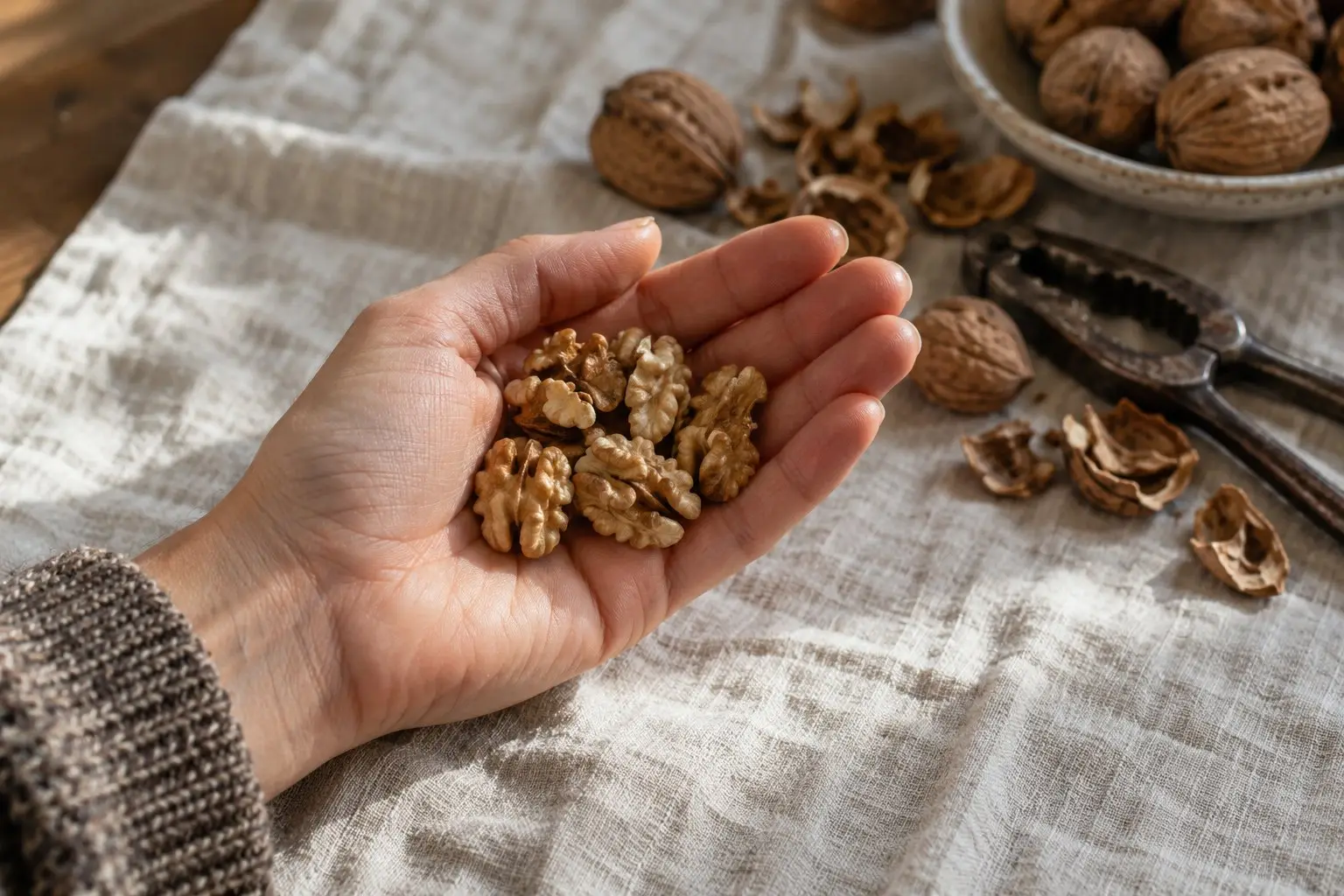
A handful or two of walnuts a day matches the amounts in the longest trial and in the US health claim. In trials, walnut-rich diets lowered LDL cholesterol a little and didn’t cause weight gain, even over two years. Walnuts are a good habit for the heart, although the longest trial was funded by the walnut industry.
Key takeaways
- The longest trial used 30 to 60 grams of walnuts a day, close to the 1.5 ounces in the US health claim.
- Across 26 trials, walnut-rich diets lowered total and LDL cholesterol modestly, and more so against a typical Western diet.
- In a two-year trial with 708 older adults, body weight stayed stable despite the extra calories.
- In that trial, LDL fell more in men than in women.
- The longest trial was funded by the California Walnut Commission, so the size of the effect matters more than the headline.
What do walnuts do to cholesterol?
Walnuts lower cholesterol a little. A Harvard-led review of 26 controlled trials with 1,059 participants compared walnut-enriched diets with control diets. Total cholesterol fell about 7 mg/dL more, LDL about 5.5 mg/dL more and triglycerides about 5 mg/dL more on the walnut diets, while blood pressure and body weight didn’t change. When walnuts were compared with typical American or Western diets, the drop in cholesterol was larger (Guasch-Ferré et al., 2018).
Those are modest numbers. Walnuts won’t replace a statin for someone who needs one, but as part of an overall diet they move cholesterol in the right direction. The eggs and cholesterol article covers the other side of the plate, what cholesterol from food does.
How many walnuts did the two-year study use?
The longest walnut trial, called WAHA, ran in Loma Linda, California, and in Barcelona. It randomly assigned 708 healthy older adults, average age 69, either to add walnuts to their usual diet, about 15 percent of their calories or 30 to 60 grams a day, or to avoid them. After two years, the walnut group had lower total and LDL cholesterol and fewer small LDL particles. LDL fell by about 8 percent in men and about 3 percent in women (Rajaram et al., 2021).
Do walnuts make you gain weight?
Walnuts did not make people gain weight in the trials. In the two-year WAHA trial, body weight stayed practically unchanged in the walnut group despite the extra calories (Rajaram et al., 2021). The pooled review of 26 trials found the same for body weight (Guasch-Ferré et al., 2018), which answers the most common worry about nuts.
Who pays for walnut research?
Walnut research is often paid for by the walnut industry. The WAHA trial was funded by the California Walnut Commission, and several of its authors had received research funding from it or served on its advisory boards. The authors state that the commission had no role in the design, analysis or writing (Rajaram et al., 2021). The US qualified health claim for walnuts also came from a petition by the commission; it says that about 1.5 ounces a day, as part of a diet low in saturated fat and cholesterol, without adding calories, may reduce the risk of coronary heart disease, and that the evidence is supportive but not conclusive (FDA, 2004).
Industry funding doesn’t make a randomized trial wrong, but it is a reason to look at the size of the effect rather than the press release. Here the size is modest and consistent, which is about as reassuring as nutrition research gets.
What I’d do
- Eat a small handful of walnuts most days.
- Use them instead of a less healthy snack or as a topping on oats, yogurt or salad, rather than on top of everything else you eat.
- Measure 30 to 60 grams a couple of times, so you know what your handful looks like.
- Eat them alongside fiber-rich foods such as oats, as the fiber article suggests for a healthy diet overall.
- Pair them with olive oil rather than butter for a heart-friendly plate, as the olive oil article discusses.
- Get your omega-3 from food first; whether capsules add anything is covered in Are fish oil supplements worth taking?
Frequently asked questions
Are walnuts a good source of omega-3? They contain the plant omega-3 alpha-linolenic acid, and in the two-year trial the walnut group took in more of it (Rajaram et al., 2021). Whether this plant form does the same as the omega-3s in oily fish is a separate question, so I wouldn’t count walnuts as a fish replacement. How much fish is worth eating, and which species to limit for mercury, is covered in how much fish is safe to eat a week.
Can I eat too many walnuts? In the long trial, up to about 60 grams a day didn’t change body weight (Rajaram et al., 2021). Beyond that, the calories add up quickly.
Do walnuts lower blood pressure? Not in the pooled analysis of 26 trials, where blood pressure didn’t change (Guasch-Ferré et al., 2018).
Are walnuts better than almonds? The sources here compare walnuts with control diets, not with other nuts, so they can’t rank them. The best nut is the one you’ll actually eat regularly. How nuts in general relate to a longer life is covered in Do nuts help you live longer?
Sources
- Guasch-Ferré, M., Li, J., Hu, F. B., Salas-Salvadó, J., & Tobias, D. K. (2018). Effects of walnut consumption on blood lipids and other cardiovascular risk factors: An updated meta-analysis and systematic review of controlled trials. The American Journal of Clinical Nutrition, 108(1), 174–187. https://doi.org/10.1093/ajcn/nqy091
- Rajaram, S., Cofán, M., Sala-Vila, A., Haddad, E., Serra-Mir, M., Bitok, E., et al. (2021). Effects of walnut consumption for 2 years on lipoprotein subclasses among healthy elders: Findings from the WAHA randomized controlled trial. Circulation, 144(13), 1083–1085. https://doi.org/10.1161/circulationaha.121.054051 (Funded by the California Walnut Commission; several authors received research funding from it.)
- U.S. Food and Drug Administration. (2004, March 9). Qualified health claims: Letter of enforcement discretion – Walnuts and coronary heart disease (Docket No. 02P-0292). Archived page