Is honey healthier than sugar?
Why honey counts as sugar in every official guideline, what happened when people ate honey or table sugar for two weeks each, and where honey earns its place.

Katja Michel, M.Ed. · 5 min read
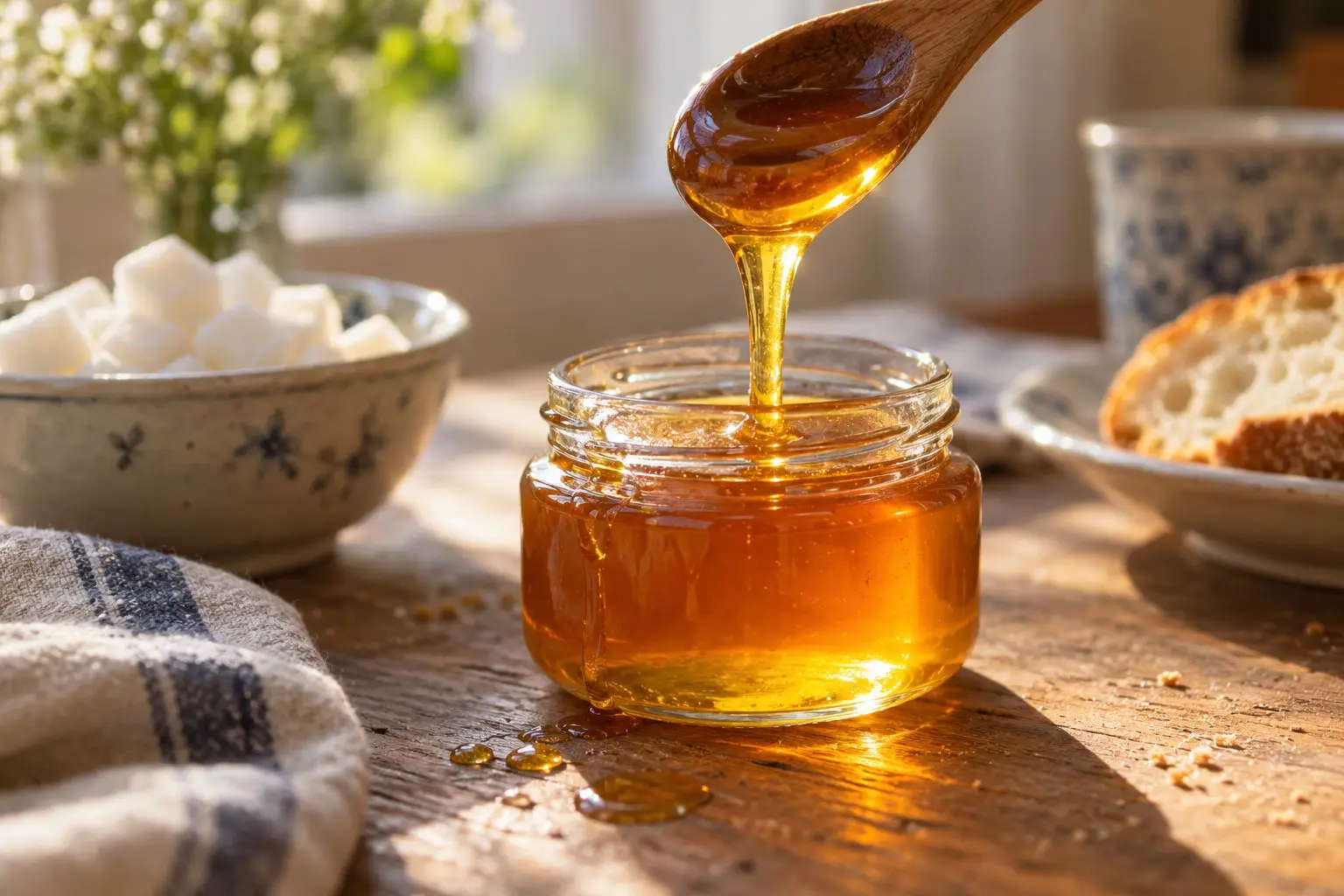
Honey is only slightly different from table sugar, and your body treats both mainly as sugar. When adults ate the same amount of carbohydrate from honey or from table sugar in a controlled trial, their blood sugar and insulin responded the same way, and their weight didn’t change. Honey has a few real uses, such as soothing a child’s cough, but it belongs in the same daily sugar budget as the white stuff.
Key takeaways
- The World Health Organization and the US Food and Drug Administration both count honey as a free or added sugar.
- Honey is about four fifths sugar, mostly fructose and glucose, and the rest is largely water.
- The trials that made honey look healthy mostly added it to people’s usual diet instead of comparing it with sugar.
- In several trials, honey eased children’s coughs better than no treatment or a placebo.
- Babies under one year should never get honey, because it can carry the bacteria that cause botulism.
What is honey actually made of?
Honey is mostly sugar and water. According to the US Department of Agriculture, its sugars are mainly fructose and glucose, with a little sucrose (U.S. Department of Agriculture, n.d.-a). White sugar is almost pure sucrose (U.S. Department of Agriculture, n.d.-b), which your gut splits into the same two sugars, glucose and fructose, in equal parts.
Honey and white sugar, per 100 grams
| Honey | White sugar | |
|---|---|---|
| Calories | 304 | 387 |
| Total sugars | 82 g | 99.8 g |
| Fructose | 41 g | none until digested |
| Water | 17 g | almost none |
Values from USDA FoodData Central (FDC IDs 169640 and 169655).
Gram for gram, honey has fewer calories only because some of it is water. It also contains small amounts of acids, enzymes and minerals (Ahmed et al., 2023). The amounts are small, which is why health agencies don’t treat honey differently: the World Health Organization and the US Food and Drug Administration include it in their definitions of free or added sugars (Ahmed et al., 2023). How much of that budget fits into a day is explained in How much sugar a day is too much?
Does honey raise your blood sugar less than sugar?
Honey did not raise blood sugar less than table sugar in the one trial that compared them directly. A US research team had 55 adults eat 50 grams of carbohydrate a day from honey, from table sugar and from high-fructose corn syrup, each for two weeks in random order with a break in between. Twenty-eight of them had normal blood sugar control and 27 had impaired glucose tolerance, an early stage of blood sugar problems. Fasting glucose and insulin didn’t differ between the three sweeteners, neither did the blood sugar curve after a glucose drink, and body weight stayed the same. Triglycerides, the fats in the blood, rose with all three, and in the group with impaired glucose tolerance, C-reactive protein, a marker of inflammation, rose with all three as well (Raatz et al., 2015).
Two weeks is short, and 55 people is a small group. But the trial asked exactly the question most people have when they pour honey instead of sugar, and the measurements showed no difference.
Why do some studies say honey is good for you?
The studies that make honey look healthy mostly compared it with eating no extra sweetener at all, which is a different question. A Canadian team pooled 18 controlled trials with 1,105 participants who ate a median of 40 grams of honey a day for about eight weeks. Honey slightly lowered fasting blood sugar, cholesterol and triglycerides, and it raised HDL cholesterol a little. Most of these results had low certainty, and raw honey and honey from a few specific flowers, such as robinia and clover, did best (Ahmed et al., 2023).
The detail that changes the reading sits in the methods. In 70 percent of the trials, honey was compared with people’s usual diet, and only 15 percent compared it with table sugar. The authors themselves conclude that honey may help “when consumed within a healthy dietary pattern” and call for more research. One author has received research support from the National Honey Board (Ahmed et al., 2023).
Is the honey you buy really honey?
Not always: in a European investigation, almost half of the sampled imported honey was suspected of being stretched with sugar syrup. In an EU-wide check, authorities randomly sampled 320 honey shipments imported from 20 countries between November 2021 and February 2022. Of these, 147 were suspected of being adulterated, and the Commission’s scientists report that fraudsters now mostly use syrups made from rice, wheat or sugar beet. A suspicious result isn’t proof, which is why investigators followed up by inspecting importers and packers (European Commission, 2023).
That gives one more reason not to pay a premium for health effects. If you buy honey, buy it because you like how it tastes, ideally from a beekeeper you can ask.
What I’d do
- Use honey where its flavor makes the dish better, in yogurt, tea or a dressing, and count it as sugar.
- Skip the switch from sugar to honey as a health project, since the body handled them the same in the direct comparison. Fruit juice raises a similar question, which Is fruit juice healthy? answers.
- Try a spoonful of honey for a child’s nighttime cough if they are older than one year.
- Never give honey, or anything made with it, to a baby under one year.
Frequently asked questions
Does honey help with a cough? For children older than one year, probably a little. A Cochrane review of six trials with 899 children found that honey probably eased coughing more than no treatment or a placebo, mostly during the first three days, and it may work about as well as the cough medicine dextromethorphan. Some children had stomach complaints, restlessness or trouble sleeping (Oduwole et al., 2018). If a cough lasts or a child has trouble breathing, see a doctor.
Why can’t babies have honey? Honey can contain the bacteria that cause botulism, a rare but serious illness, and the CDC says not to feed honey, including honey on pacifiers, to children younger than one year (Centers for Disease Control and Prevention, 2026).
Is raw honey healthier than regular honey? In the pooled analysis, raw honey showed more favorable effects on blood sugar and cholesterol than processed honey, but only five trial comparisons used raw honey, so the certainty is low (Ahmed et al., 2023). Raw honey also carries the same botulism warning for babies.
Is honey better than sugar for people with diabetes? The direct comparison above included people with early blood sugar problems, and honey did no better than table sugar for them (Raatz et al., 2015). If you have diabetes, ask your doctor or diabetes educator how to fit any sweetener into your plan.
Sources
- Ahmed, A., Tul-Noor, Z., Lee, D., Bajwah, S., Ahmed, Z., Zafar, S., et al. (2023). Effect of honey on cardiometabolic risk factors: A systematic review and meta-analysis. Nutrition Reviews, 81(7), 758–774. https://doi.org/10.1093/nutrit/nuac086 (Funded by the Canadian Institutes of Health Research; one author has received research support from the National Honey Board.)
- Centers for Disease Control and Prevention. (2026, February 26). Preventing botulism. https://www.cdc.gov/botulism/prevention/index.html
- European Commission. (2023, March 23). Food fraud: How genuine is your honey? https://joint-research-centre.ec.europa.eu/jrc-news/food-fraud-how-genuine-your-honey-2023-03-23_en
- Oduwole, O., Udoh, E. E., Oyo-Ita, A., & Meremikwu, M. M. (2018). Honey for acute cough in children. Cochrane Database of Systematic Reviews, 4, CD007094. https://doi.org/10.1002/14651858.cd007094.pub5
- Raatz, S. K., Johnson, L. K., & Picklo, M. J. (2015). Consumption of honey, sucrose, and high-fructose corn syrup produces similar metabolic effects in glucose-tolerant and -intolerant individuals. The Journal of Nutrition, 145(10), 2265–2272. https://doi.org/10.3945/jn.115.218016
- U.S. Department of Agriculture. (n.d.-a). Honey (FoodData Central, FDC ID 169640). https://fdc.nal.usda.gov/food-details/169640/nutrients
- U.S. Department of Agriculture. (n.d.-b). Sugars, granulated (FoodData Central, FDC ID 169655). https://fdc.nal.usda.gov/food-details/169655/nutrients