What do people in the Blue Zones really eat?
From a map of Sardinia to Adventist and Okinawan records: what the evidence says Blue Zone people ate, and why some researchers doubt the age records.

Katja Michel, M.Ed. · 6 min read

People in the so-called Blue Zones are known for plant-heavy, modest diets, but the hard data are thinner than the books suggest. The best come from the Seventh-day Adventists in California, where vegetarians lived somewhat longer than meat eaters, and from older Okinawans, who ate few calories for decades. Some researchers doubt how many of the oldest people in these regions really reached the ages on record, so the lessons are better taken as patterns than as proof.
Key takeaways
- The term Blue Zone was first used for a mountainous area of Sardinia where unusually many men reached 100.
- Among Seventh-day Adventists in North America, vegetarians had a lower risk of dying than meat eaters over about six years.
- Older Okinawans ate few calories and stayed lean for most of their lives.
- A critique, not yet published in a peer-reviewed journal, argues that many extreme age records reflect missing birth certificates and errors.
- The Blue Zones approach itself stresses daily environment and routine as much as any single food.
Where does the idea of Blue Zones come from?
The term comes from a map of Sardinia. In 2004, researchers calculated what share of people born on the island between 1880 and 1900 had become validated centenarians. They found the highest rates in the mountainous central-eastern part, marked it in blue and called it the “Blue Zone”. Men there were especially likely to reach 100. The researchers said the reasons were unknown and suggested both environment and a genetic pool shaped by isolation and marriages within families as possibilities (Poulain et al., 2004).
The idea later grew into five regions: Sardinia, Okinawa in Japan, the Seventh-day Adventist community in Loma Linda in California, Nicoya in Costa Rica and Ikaria in Greece. Dan Buettner, whose fieldwork identified these regions, summarizes the lessons as an environment that makes healthy choices easy and almost unconscious, not as a single diet (Buettner, 2025).
What do the Adventist data show?
The Adventists provide the strongest evidence, because they are a large group with detailed records. The Adventist Health Study 2 followed 73,308 Seventh-day Adventists in North America for almost six years on average. Vegetarians as a group had a 12 percent lower risk of dying than non-vegetarians after adjusting for other factors, and people who ate fish but no other meat had the lowest risk. The links were clearer in men than in women (Orlich et al., 2013).
Vegetarian Adventists may also differ from non-vegetarian ones in other habits. The study adjusted for many lifestyle factors, but observational data can’t fully separate diet from the rest of life.
What did older Okinawans eat?
Older Okinawans ate few calories for most of their lives. Researchers looked at six decades of records on Okinawans aged 65 and older and found low calorie intake and a negative energy balance at younger ages, little weight gain with age, a low body mass index throughout life and a low risk of dying from age-related diseases (Willcox et al., 2007). The authors see this as support for the idea that eating less can slow aging in humans, a question covered in Does eating less help you live longer? These findings describe one generation of older Okinawans.
Are the Blue Zone age records reliable?
Possibly not all of them, according to one critique. The researcher Saul Newman analyzed supercentenarians, people said to have reached 110, in several countries. In the United States, the number of such records fell sharply once states introduced birth certificates, and he found that the Blue Zones of Sardinia, Okinawa and Ikaria had lower incomes and shorter average life expectancy than the rest of their countries. He concluded that fraud and clerical error play a large role in extreme age records (Newman, 2019). This work is a preprint, which means it hasn’t passed peer review in a journal, and the Sardinian team had worked with validated centenarians.
The fair reading is that the most dramatic claims are the least secure. The everyday lessons, such as eating mostly plants and staying socially connected, don’t depend on the age records.
What can you take from the Blue Zones?
The habits that other research also covers, such as eating beans, having a sense of purpose and keeping close friendships. Beans and other legumes have their own evidence, as Are beans good for you? shows. Purpose and friendships are part of the same story; see Does having a purpose help you live longer? and Do friends help you live longer?
What I’d do
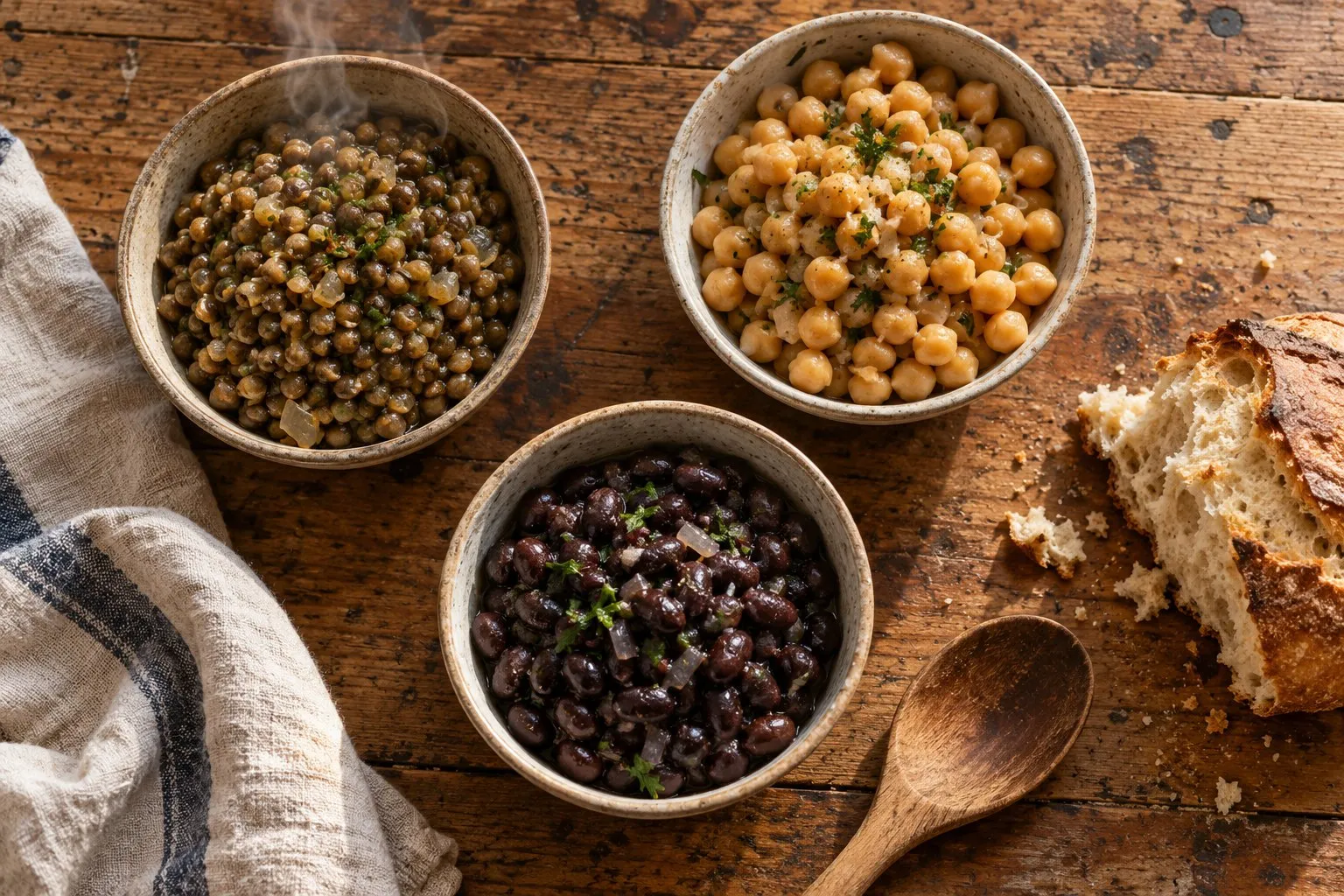
- Eat beans, lentils or chickpeas most days.
- Build meals around vegetables and whole grains, with meat as a side.
- Arrange your home and routine so that walking and cooking are the easy option.
- Stay in regular contact with friends and family.
- Read headlines about record ages with healthy skepticism.
Frequently asked questions
Do people in the Blue Zones eat meat? In the Adventist study, pesco-vegetarians, who eat fish but no other meat, had the lowest risk of dying, while semi-vegetarians, who eat meat now and then, showed no clear difference from regular meat eaters (Orlich et al., 2013).
Can I copy the Blue Zone diet at home? The sources here describe patterns, not a tested diet plan. The strongest data link vegetarian eating to a lower risk of dying among Adventists, and observational data can’t fully separate diet from the rest of life (Orlich et al., 2013).
Is it the genes? Possibly in part. The Sardinian researchers raised the idea that a closed gene pool might protect people in the region, but they couldn’t confirm it (Poulain et al., 2004).
Sources
- Buettner, D. (2025). Lessons from the Blue Zones: There is no silver bullet (or magic pill) for a long, healthy life. American Journal of Lifestyle Medicine, 19(7), 1052–1062. https://doi.org/10.1177/15598276251334310
- Newman, S. J. (2019). Supercentenarian and remarkable age records exhibit patterns indicative of clerical errors and pension fraud [Preprint]. bioRxiv. https://doi.org/10.1101/704080
- Orlich, M. J., Singh, P. N., Sabaté, J., Jaceldo-Siegl, K., Fan, J., Knutsen, S., et al. (2013). Vegetarian dietary patterns and mortality in Adventist Health Study 2. JAMA Internal Medicine, 173(13), 1230–1238. https://doi.org/10.1001/jamainternmed.2013.6473
- Poulain, M., Pes, G. M., Grasland, C., Carru, C., Ferrucci, L., Baggio, G., et al. (2004). Identification of a geographic area characterized by extreme longevity in the Sardinia island: The AKEA study. Experimental Gerontology, 39(9), 1423–1429. https://doi.org/10.1016/j.exger.2004.06.016
- Willcox, B. J., Willcox, D. C., Todoriki, H., Fujiyoshi, A., Yano, K., He, Q., et al. (2007). Caloric restriction, the traditional Okinawan diet, and healthy aging: The diet of the world’s longest-lived people and its potential impact on morbidity and life span. Annals of the New York Academy of Sciences, 1114, 434–455. https://doi.org/10.1196/annals.1396.037