Plant protein vs animal protein: which is better?
Muscle trials and cohorts of more than a million people show where beans and soy, and meat, eggs and dairy, each have the edge.

Katja Michel, M.Ed. · 5 min read
Swapping animal for plant protein
People who got a few percent more of their calories from plant protein instead of animal protein had a lower risk of dying during the studies.
Pooled risk of death when 3 to 5 percent of calories came from plant instead of animal protein (no swap = 1.00), nine cohort studies
For building muscle, plant protein works almost as well as animal protein when you eat enough of it, and for a long life it may work better. Animal protein has a small edge for gaining lean mass in younger adults, while people who get more of their protein from plants tend to live longer. All of this comes from short trials and observational studies, so the long-term picture rests on links, not proof.
Key takeaways
- Animal protein is usually a stronger trigger for building muscle in lab studies, but in longer trials the difference was small.
- Young vegan men who ate as much protein as omnivores gained the same muscle and strength from strength training.
- In pooled cohort data, plant protein was linked with fewer deaths from heart disease, and animal protein wasn’t.
- Swapping a small share of calories from animal to plant protein was linked to a lower risk of death in several large cohorts.
Does plant protein build muscle as well as animal protein?
Plant protein builds muscle nearly as well as animal protein, if the amount is right. Short lab studies often show a weaker muscle-building response after plant protein, which is why animal protein has a reputation for being superior. In a trial that tested this over 12 weeks, 19 young men who were habitual vegans and 19 omnivores did supervised strength training twice a week, with protein raised to 1.6 grams per kilogram a day in both groups, using soy for the vegans and whey for the omnivores. Both groups gained leg muscle and strength, and the differences between them were too small to be meaningful (Hevia-Larraín et al., 2021).
A meta-analysis of 16 randomized trials found a small edge for animal protein. Protein source made no difference to absolute lean mass or to strength, but animal protein did slightly better for the percentage of lean mass, and adults under 50 gained about 0.4 kilograms more lean mass with it (Lim et al., 2021). In most of those trials, people already ate more protein than the minimum, which may help explain why the source mattered so little. How much you need in the first place is explained in How much protein do you need a day?
Does plant protein help you live longer?
Possibly: cohort studies link more plant protein to a lower risk of dying. A meta-analysis of 32 prospective cohorts with 715,128 people found that more plant protein went with a lower risk of dying from any cause and from heart disease, while animal protein showed no link with heart or cancer deaths. Each additional 3 percent of daily calories from plant protein was associated with a 5 percent lower risk of death (Naghshi et al., 2020).
A newer analysis asked a sharper question: what happens when people eat the same calories but get some of their protein from plants instead of animals? Across nine cohort studies with more than a million participants, that swap was linked to a lower risk of death overall, and the link with heart disease was stronger when the swap was larger (Barrantes-Espinola et al., 2026). On a 2,000-calorie day, 3 percent of calories is about 15 grams of protein.
These studies can’t separate protein from the foods it comes in. Plant protein arrives in foods such as beans, whole grains and nuts, so the lower risk may come from those foods as a whole and not from the protein alone.
Which plant proteins should you start with?
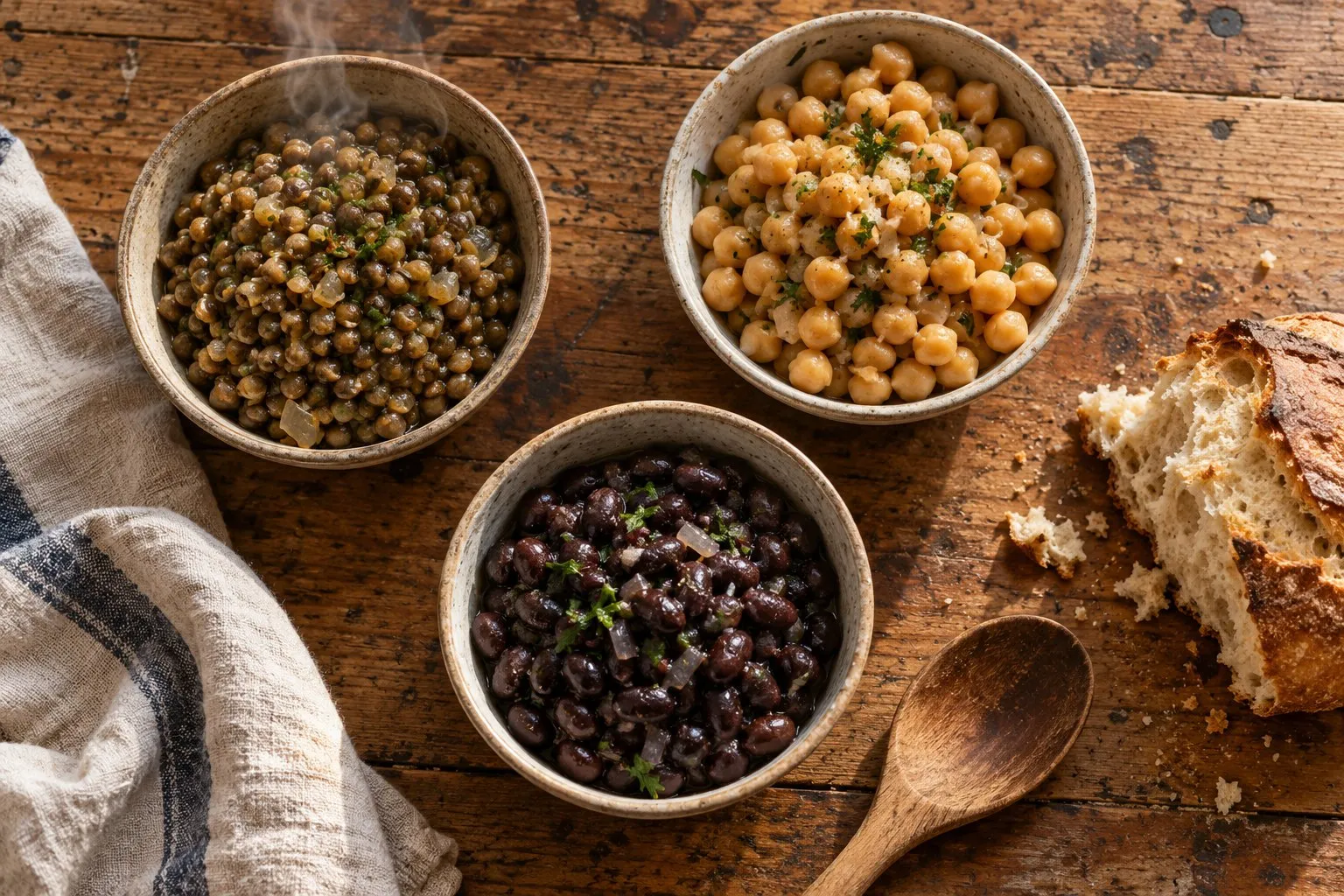
Soy and other legumes are an easy place to start, and soy was the protein the vegans relied on in the training trial above. Soy has its own myths, which Is soy bad for you? takes apart, and beans come with fiber that animal foods don’t have, as explained in Are beans good for you?
What I’d do
- Get enough protein first and worry about the source second.
- Replace some meat with beans, lentils, tofu or tempeh a few times a week.
- Make sure your total protein is high enough if you are fully plant-based and want to build muscle.
- Keep fish, eggs and dairy if you like them; the swap doesn’t need to be all or nothing.
Frequently asked questions
Do I need to combine plant proteins at every meal? No. How much protein do you need a day? explains that the minimum requirement showed no clear difference by protein source and that combining plant foods across the whole day is enough.
Is a plant protein powder as good as whey? In the vegan training trial, the vegans topped up their protein with soy protein isolate and the omnivores with whey, and both groups made similar gains in muscle and strength (Hevia-Larraín et al., 2021). That trial included only young men.
Does this apply to older adults? The trial meta-analysis found the edge for animal protein mainly in adults under 50 (Lim et al., 2021). Older adults need more protein overall, as the protein guide linked above explains, so for them the amount is the first thing to get right.
Sources
- Barrantes-Espinola, G., Alberti, P., Jaramillo-Morales, E., Rodriguez, A., & López-Moreno, M. (2026). Isocaloric substitution of animal protein with plant protein and its impact on all-cause, cardiovascular, and cancer mortality: A systematic review and meta-analysis. Clinical Nutrition, 61, 106654. https://doi.org/10.1016/j.clnu.2026.106654
- Hevia-Larraín, V., Gualano, B., Longobardi, I., Gil, S., Fernandes, A. L., Costa, L. A. R., et al. (2021). High-protein plant-based diet versus a protein-matched omnivorous diet to support resistance training adaptations: A comparison between habitual vegans and omnivores. Sports Medicine, 51(6), 1317–1330. https://doi.org/10.1007/s40279-021-01434-9
- Lim, M. T., Pan, B. J., Toh, D. W. K., Sutanto, C. N., & Kim, J. E. (2021). Animal protein versus plant protein in supporting lean mass and muscle strength: A systematic review and meta-analysis of randomized controlled trials. Nutrients, 13(2), 661. https://doi.org/10.3390/nu13020661
- Naghshi, S., Sadeghi, O., Willett, W. C., & Esmaillzadeh, A. (2020). Dietary intake of total, animal, and plant proteins and risk of all cause, cardiovascular, and cancer mortality: Systematic review and dose-response meta-analysis of prospective cohort studies. BMJ, 370, m2412. https://doi.org/10.1136/bmj.m2412