Is soy bad for you?
What 41 clinical studies found about soy and testosterone, how soy foods relate to breast cancer in women who already had it, and what soy does for cholesterol.

Katja Michel, M.Ed. · 6 min read
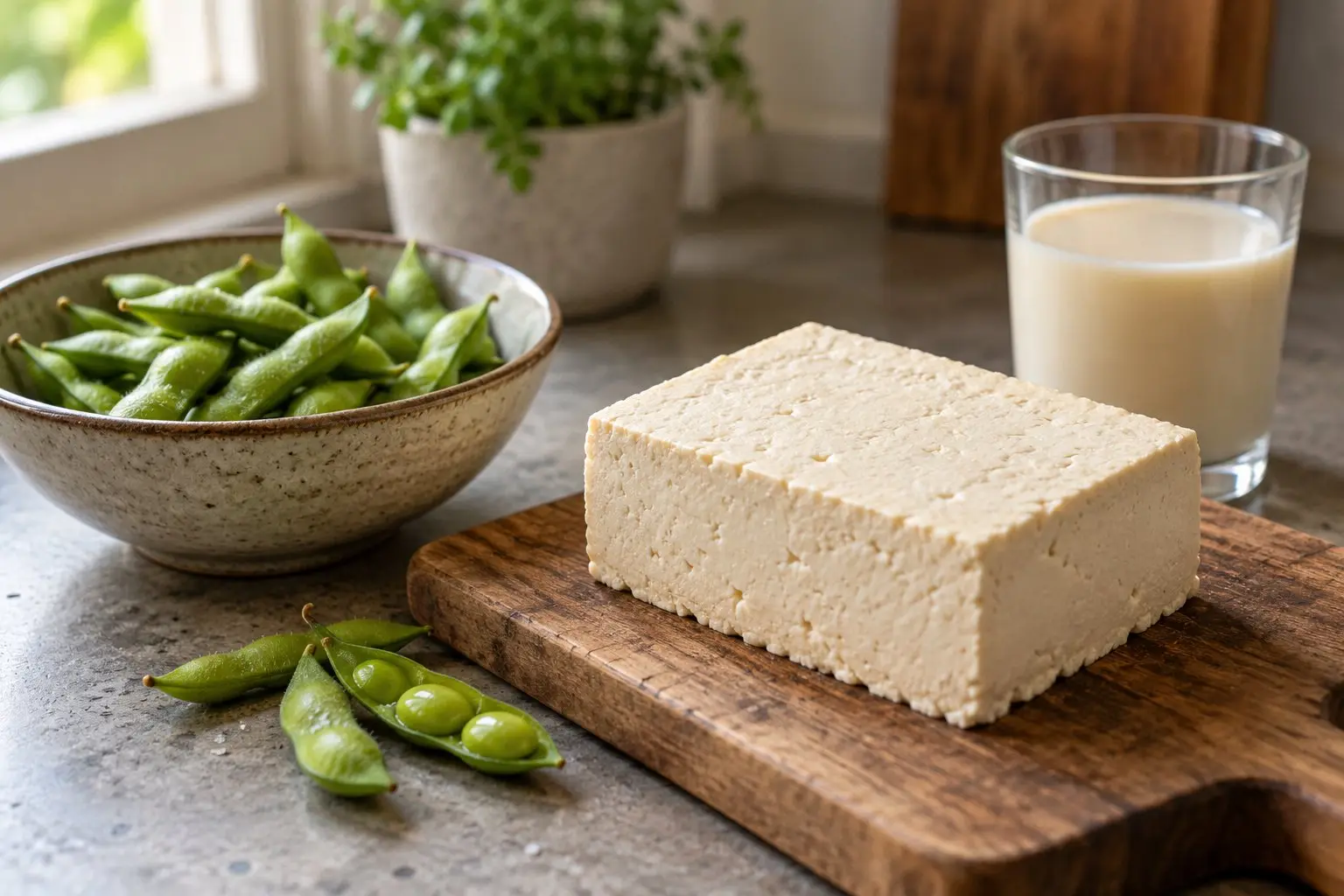
Soy foods such as tofu, tempeh, edamame and soy milk are safe for most people, and the fear that they disturb your hormones hasn’t held up in clinical studies. In men, soy and its plant estrogens didn’t change testosterone or estrogen levels, and in women who had survived breast cancer, eating soy went with fewer recurrences in large observational studies. Soy protein also lowers LDL cholesterol a little.
Key takeaways
- Isoflavone pills are not the same as soy foods, because the breast cancer studies looked at foods.
- Pooled clinical studies in men found no effect of soy or isoflavone pills on testosterone, free testosterone or estrogen, regardless of dose or duration.
- In more than 9,000 breast cancer survivors in the United States and China, women who ate more soy after diagnosis had their cancer return less often.
- Soy protein lowered LDL cholesterol by a few percent in the trials the FDA itself selected.
- The authors behind several of the reassuring reviews have ties to soy research groups, which they disclose.
Why do people worry that soy affects hormones?
The worry comes from isoflavones, plant compounds in soybeans that can act like a weak form of estrogen and also, in some situations, block it. Researchers describe them as having both estrogen-like and anti-estrogen properties, which is why they have been studied as possible protection against breast cancer and as a possible risk for breast cancer survivors at the same time (Nechuta et al., 2012).
Studies and case reports describing feminizing effects in men, such as lower testosterone, have added to the fear, and they are the reason researchers kept testing the question in controlled studies (Reed et al., 2021).
Does soy lower testosterone in men?
No, according to the controlled studies. A first meta-analysis in 2010 analyzed fifteen placebo-controlled treatment groups and found no effect of soy protein or isoflavones on testosterone, the hormone that binds it, or free testosterone (Hamilton-Reeves et al., 2010). An expanded analysis in 2021 included 41 studies in which adult men ate soy foods, soy protein or isoflavone extracts. Testosterone was measured in 1,753 men and estradiol in 1,000, and neither soy protein nor isoflavones changed any of the hormones measured, whatever the dose or duration (Reed et al., 2021).
Both analyses list Messina among their authors, a researcher affiliated with the Soy Nutrition Institute (Blanco Mejia et al., 2019). The data come from many independent trials, but it is fair to know who pooled them. For men who want to eat less meat, tofu and tempeh are a solid protein source; how much protein you need is explained in How much protein do you need a day?, and how soy compares with animal protein is covered in Plant protein vs animal protein
Is soy safe after breast cancer?
The large observational studies suggest that soy foods don’t harm breast cancer survivors and may even help. The After Breast Cancer Pooling Project combined two US cohorts and one Chinese cohort with 9,514 women diagnosed with invasive breast cancer between 1991 and 2006, who were followed for an average of 7.4 years. Women who ate at least 10 milligrams of soy isoflavones a day after their diagnosis had a 25 percent lower risk of their cancer coming back. Deaths from breast cancer and from any cause were also lower, but those differences could have been chance (Nechuta et al., 2012).
The pattern held in both countries, although Chinese women ate far more soy than American women. These are observational data, so soy eaters may differ in other ways, and the studies looked at soy foods, not isoflavone pills. If you have had breast cancer, ask your oncologist how soy fits into your diet, especially if you take hormone therapy.
Does soy lower cholesterol?
Yes, soy protein lowers LDL cholesterol by a small amount. When the FDA was considering whether to revoke the heart health claim for soy protein, researchers analyzed the 46 controlled trials the agency had picked for its review. In the 41 trials with LDL data, about 25 grams of soy protein a day for a median of six weeks lowered LDL cholesterol by about 5 milligrams per deciliter compared with other proteins, roughly 3 to 4 percent (Blanco Mejia et al., 2019).
That is a modest effect, similar in kind to what beans do, which are covered in Are beans good for you? The corresponding author has received grants from soy industry groups, among many other funders, and the analysis itself was funded by the Canadian Institutes of Health Research (Blanco Mejia et al., 2019).
What I’d do
- Eat tofu, tempeh, edamame or soy milk as part of a normal diet if you like them.
- Prefer soy foods to isoflavone supplements, which the breast cancer data didn’t test.
- Swap some red or processed meat for soy, a change the red meat article explains.
- Ask your oncologist about soy if you have had breast cancer and take hormone therapy.
Frequently asked questions
Are isoflavone supplements the same as soy foods? Not for the evidence. The hormone analyses in men included isoflavone extracts and found no effect (Reed et al., 2021), but the breast cancer studies measured soy foods, so their reassurance doesn’t extend to pills.
Does soy affect the thyroid? The studies discussed here didn’t measure thyroid function, so I can’t answer from them. If you have a thyroid condition, ask your doctor how soy fits into your diet.
Is soy safe for children? The hormone trials above included only adult men, and the breast cancer studies only adult women. For children’s diets, ask your pediatrician, especially about soy-based infant formula.
Sources
- Blanco Mejia, S., Messina, M., Li, S. S., Viguiliouk, E., Chiavaroli, L., Khan, T. A., et al. (2019). A meta-analysis of 46 studies identified by the FDA demonstrates that soy protein decreases circulating LDL and total cholesterol concentrations in adults. The Journal of Nutrition, 149(6), 968–981. https://doi.org/10.1093/jn/nxz020 (Funded by the Canadian Institutes of Health Research; M. Messina is affiliated with the Soy Nutrition Institute; the corresponding author has received grants from soy industry groups.)
- Hamilton-Reeves, J. M., Vazquez, G., Duval, S. J., Phipps, W. R., Kurzer, M. S., & Messina, M. J. (2010). Clinical studies show no effects of soy protein or isoflavones on reproductive hormones in men: Results of a meta-analysis. Fertility and Sterility, 94(3), 997–1007. https://doi.org/10.1016/j.fertnstert.2009.04.038
- Nechuta, S. J., Caan, B. J., Chen, W. Y., Lu, W., Chen, Z., Kwan, M. L., et al. (2012). Soy food intake after diagnosis of breast cancer and survival: An in-depth analysis of combined evidence from cohort studies of US and Chinese women. The American Journal of Clinical Nutrition, 96(1), 123–132. https://doi.org/10.3945/ajcn.112.035972
- Reed, K. E., Camargo, J., Hamilton-Reeves, J., Kurzer, M., & Messina, M. (2021). Neither soy nor isoflavone intake affects male reproductive hormones: An expanded and updated meta-analysis of clinical studies. Reproductive Toxicology, 100, 60–67. https://doi.org/10.1016/j.reprotox.2020.12.019