Is red meat bad for you?
Bacon and steak carry different risks, and the WHO cancer label rates how certain the evidence is, with no word on how large the risk is.

Katja Michel, M.Ed. · 6 min read
How many of the five long-life habits do you have? Take the one-minute test
Swapping red meat
Replacing a daily serving of red meat with nuts, poultry or whole grains went with a lower risk of death.
Risk of dying during follow-up after swapping 1 daily serving of red meat (keeping red meat = 100), 121,342 US adults
Processed meat such as bacon, ham and sausages is clearly linked to colorectal cancer, and eating it daily also goes with a higher risk of dying early. Unprocessed red meat such as steak or a pork chop carries a smaller and less certain risk. Cancer researchers couldn’t say whether any amount is completely safe, and the World Cancer Research Fund suggests a few modest portions of red meat a week at most and processed meat only rarely.
Key takeaways
- The WHO’s cancer agency places processed meat in its highest group, which describes how certain the evidence is, not how large the risk is.
- For an individual, the extra colorectal cancer risk from daily processed meat is small, but it adds up across a population.
- In large American cohorts, processed meat went with a higher risk of death than unprocessed red meat.
- One review panel judged the same evidence too weak to tell people to change their habits.
- What you eat instead of red meat matters as much as the meat itself.
What counts as red and processed meat?
Red meat is the muscle meat of mammals: beef, veal, pork, lamb, mutton, goat and horse. Processed meat is meat that has been salted, cured, fermented or smoked to make it taste better or keep longer, such as hot dogs, ham, sausages, corned beef, beef jerky and canned meat. Most of it is made from pork or beef, but it can also contain poultry (IARC, 2015a). So a turkey ham counts as processed meat, and a lamb chop counts as red meat.
Is processed meat really as bad as smoking?
Processed meat is not as dangerous as smoking, and this is the most misunderstood part of the story. In 2015, a working group of 22 experts from 10 countries at the International Agency for Research on Cancer (IARC), the WHO’s cancer agency, reviewed more than 800 studies. It classified processed meat as carcinogenic to humans, its Group 1, because the evidence that it causes bowel cancer was sufficient. Red meat went into Group 2A, probably carcinogenic, based on limited evidence in people and strong evidence from laboratory mechanisms (IARC, 2015a).
Tobacco is in Group 1 too, which is why so many headlines compared sausages to cigarettes. The groups only say how sure the experts are that something can cause cancer. They don’t say how much risk a given amount brings (IARC, 2015b).
The size of the risk is in another sentence of the same report: each 50-gram portion of processed meat eaten daily raised the risk of colorectal cancer by 18 percent (IARC, 2015a). Fifty grams is about one hot dog or a little less than four slices of bacon (Pan et al., 2012). About 3.9 in 100 Americans are diagnosed with colorectal cancer during their lifetime (National Cancer Institute, n.d.). As a rough illustration of my own, a relative increase of 18 percent applied to that figure would mean about 4.6 instead of 3.9 in 100, a little under one more case per 100 people who eat such a portion every day. It is only a rough picture, because the average already includes people who eat processed meat. IARC’s own head of the program said the same in words: for an individual the risk remains small, and it grows with the amount eaten (IARC, 2015a). The data didn’t allow the experts to say whether a safe level exists (IARC, 2015b).
How risky is unprocessed red meat?
Unprocessed red meat carries less risk than processed meat, and here the experts disagree in public. Harvard researchers followed 121,342 nurses and health professionals for up to 28 years. Each extra daily serving of unprocessed red meat, about 85 grams or a small steak, went with a 13 percent higher risk of dying during the study, and each daily serving of processed red meat with a 20 percent higher risk (Pan et al., 2012).
In 2019, a group of researchers called NutriRECS reviewed 55 cohorts with more than 4 million people. They found that eating three servings fewer per week went with only a very small reduction in the risk of cardiovascular death, heart attacks, strokes or diabetes, and they rated the certainty of that evidence as low (Zeraatkar et al., 2019). Their panel then suggested that adults could continue eating red and processed meat at their current amounts, as a weak recommendation (Johnston et al., 2019). The panel’s lead author has since disclosed a 2019 start-up grant from Texas A&M AgriLife Research for research on saturated and polyunsaturated fats, paid from the university’s own funds rather than by a company (Valli et al., 2022).
Both groups looked at much the same kind of data. The Harvard team asks what the risk means across millions of people, and the NutriRECS panel asks whether the benefit for one person is large and certain enough to justify telling them to change. I find the first question more useful for processed meat, where the cancer evidence is strong, and the second fair for an occasional steak. The World Cancer Research Fund lands in between: no more than about three portions of red meat a week, about 350 to 500 grams cooked, and very little processed meat, if any (WCRF, n.d.).
What should you eat instead of red meat?
Almost any other protein source looked better than red meat in the Harvard cohorts. Swapping one daily serving of red meat for fish, poultry, nuts, legumes, low-fat dairy or whole grains went with a lower risk of dying during the study, and nuts did best (Pan et al., 2012). These are estimates from observational data, so they show what went with lower risk and cannot prove that the swap itself caused it. A large European study of ultra-processed food found its risk came mainly from ultra-processed animal products, as the ultra-processed food article describes.
Red meat also has nutritional value, as IARC’s director stressed in the same announcement (IARC, 2015a). People who eat little meat can get enough protein from other foods, as explained in How much protein do you need a day?
What I’d do
- Keep processed meat for occasions, not for daily sandwiches.
- Eat unprocessed red meat a few times a week at most, in modest portions.
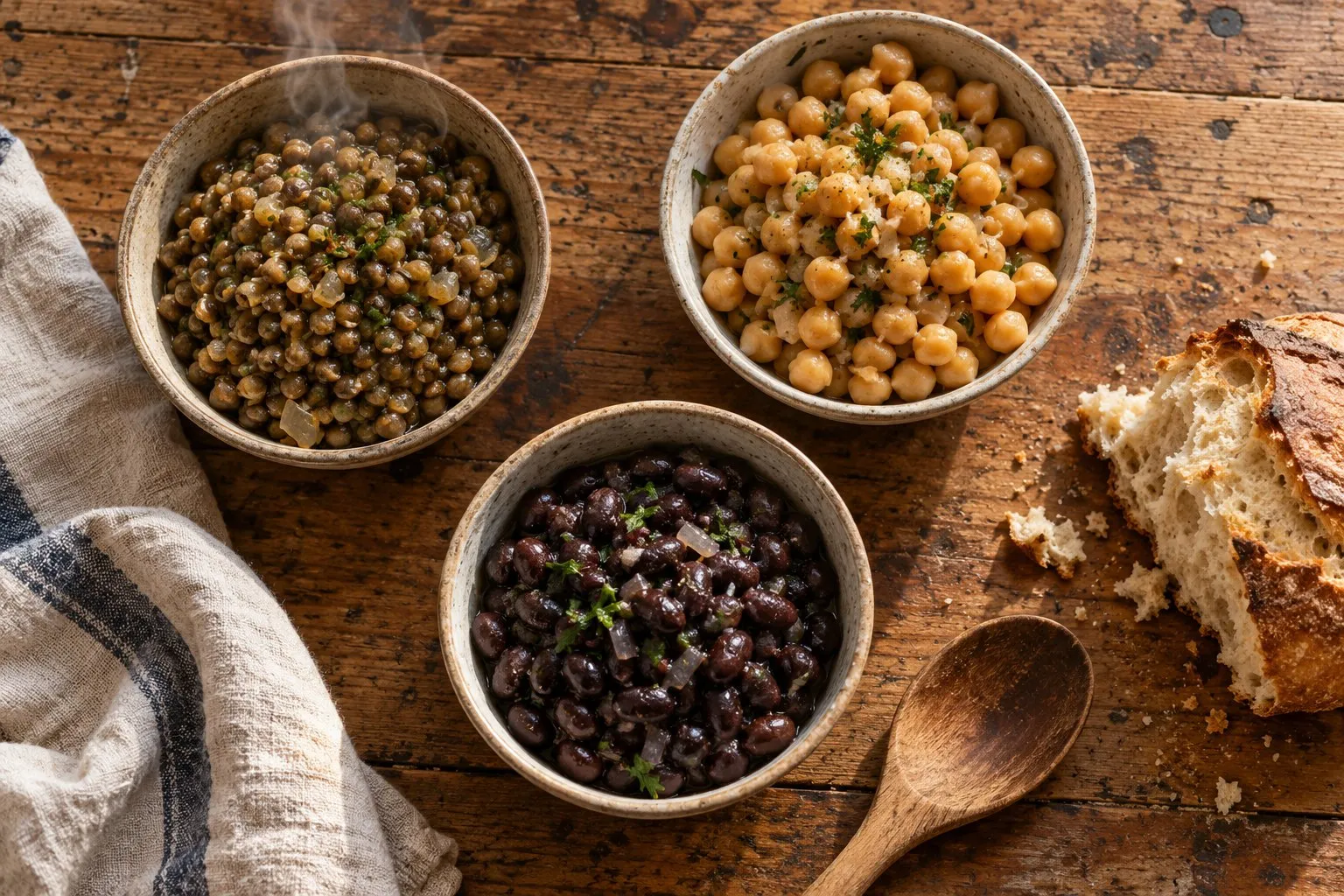
- Make beans, lentils, fish, poultry or eggs your everyday protein.
- Add a handful of nuts to your day, and see the walnut article for how many.
- Choose fresh cuts over smoked or cured versions.
Frequently asked questions
Is chicken better than red meat? In the Harvard cohorts, swapping red meat for poultry went with a lower risk of death (Pan et al., 2012). Chicken sausages and deli turkey still count as processed meat (IARC, 2015a). How chicken compares with red meat for cholesterol and heart health is covered in is chicken healthier than red meat.
Is grass-fed beef healthier? I found no good study showing that grass-fed beef changes the health risks described here. The studies measured how much red meat people ate, not how the animals were raised.
Does cooking method matter? Possibly. Cooking at high temperatures or over a flame, as in barbecuing or pan-frying, produces more of certain cancer-causing chemicals, but there weren’t enough data for IARC’s working group to say whether the cooking method changes the risk (IARC, 2015b).
Sources
- International Agency for Research on Cancer. (2015a, October 26). IARC Monographs evaluate consumption of red meat and processed meat (Press release No. 240). https://www.iarc.who.int/wp-content/uploads/2018/07/pr240_E.pdf
- International Agency for Research on Cancer. (2015b). Q&A on the carcinogenicity of the consumption of red meat and processed meat. https://www.iarc.who.int/wp-content/uploads/2018/07/Monographs-QA_Vol114.pdf
- Johnston, B. C., Zeraatkar, D., Han, M. A., Vernooij, R. W. M., Valli, C., El Dib, R., et al. (2019). Unprocessed red meat and processed meat consumption: Dietary guideline recommendations from the Nutritional Recommendations (NutriRECS) Consortium. Annals of Internal Medicine, 171(10), 756–764. https://doi.org/10.7326/m19-1621
- National Cancer Institute. (n.d.). Cancer stat facts: Colorectal cancer. Surveillance, Epidemiology, and End Results Program. https://seer.cancer.gov/statfacts/html/colorect.html
- Pan, A., Sun, Q., Bernstein, A. M., Schulze, M. B., Manson, J. E., Stampfer, M. J., et al. (2012). Red meat consumption and mortality: Results from 2 prospective cohort studies. Archives of Internal Medicine, 172(7), 555–563. https://doi.org/10.1001/archinternmed.2011.2287
- Valli, C., Maraj, M., Prokop-Dorner, A., Kaloteraki, C., Steiner, C., Rabassa, M., et al. (2022). People’s values and preferences about meat consumption in view of the potential environmental impacts of meat: A mixed-methods systematic review. International Journal of Environmental Research and Public Health, 20(1), 286. https://doi.org/10.3390/ijerph20010286
- World Cancer Research Fund. (n.d.). Limit red and processed meat. https://www.wcrf.org/research-policy/evidence-for-our-recommendations/limit-red-processed-meat/
- Zeraatkar, D., Han, M. A., Guyatt, G. H., Vernooij, R. W. M., El Dib, R., Cheung, K., et al. (2019). Red and processed meat consumption and risk for all-cause mortality and cardiometabolic outcomes: A systematic review and meta-analysis of cohort studies. Annals of Internal Medicine, 171(10), 703–710. https://doi.org/10.7326/m19-0655